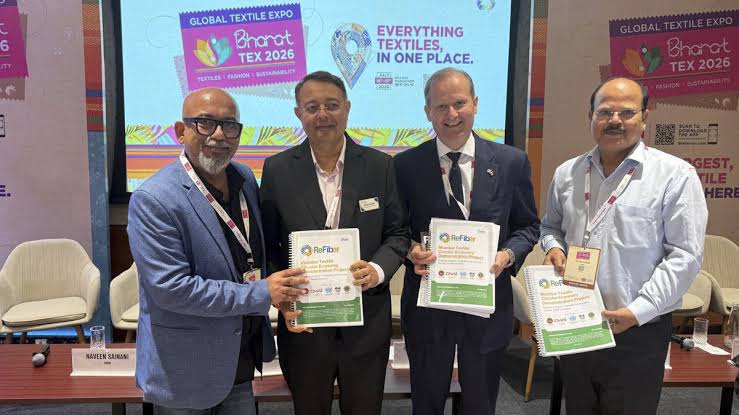
Mumbai: ReFiber, powered by OterRi, has unveiled its flagship White Paper, Mumbai Textile Circular Economy Demonstration Project, at Bharat Tex 2026, presenting one of India’s first technology-enabled models for building a city-scale circular textile ecosystem. The report showcases how digital traceability, organised collection networks and community participation can help address India’s growing post-consumer textile waste challenge while creating environmental, social and economic value.
Launched on World Environment Day 2026 at the World Trade Center Mumbai, the demonstration project was implemented by ReFiber in partnership with Tisser, the Clothing Manufacturers Association of India (CMAI), the United Nations Industrial Development Organization (UNIDO), World Trade Center Mumbai and Lions International. The initiative integrated doorstep collection, digital tracking, women-led upcycling and responsible recycling into a single circular ecosystem.
According to the White Paper, the Mumbai pilot recovered 2.7 tonnes of post-consumer textiles, fulfilled 275 collection orders from 257 citizens, and leveraged 15 laundry partners operating through 28 branches. The project demonstrated that existing urban service networks can effectively support first-mile textile collection without the need for parallel logistics infrastructure.
The report identifies six major barriers to textile circularity in India: lack of source segregation, limited citizen incentives, absence of traceability, inadequate organised collection systems, weak linkages with recyclers and upcyclers, and insufficient mechanisms to measure environmental impact. It argues that technology-enabled solutions can bridge these gaps while supporting women-led enterprises, self-help groups and local businesses involved in textile reuse and recycling.
Speaking on the occasion, Shrikant Bhangdiya, Chairman of the ReFiber Initiative, said India’s textile heritage presents a unique opportunity to transform post-consumer textile waste into a valuable resource through a transparent, traceable and scalable circular economy ecosystem.
“At ReFiber, we aim to transform post-consumer textile waste into a resource by building a transparent, traceable and scalable circular economy ecosystem. The Navi Mumbai pilot has demonstrated how technology, citizen participation and collaboration can create environmental, social and economic value, paving the way for a circular textile future for Maharashtra and India” Mr. Bhangdiya said.
Manoj Wanvari, COO of OterRi and ReFiber, said the demonstration project marks an important milestone in developing a scalable textile circularity model driven by technology, data-led insights and ecosystem partnerships.
“The Mumbai Textile Circular Economy Demonstration Project is a significant milestone in our journey to build a scalable textile circularity model through technology, data-led insights and ecosystem collaboration. We plan to take this model forward by building city-wide, state-level and eventually national circular textile infrastructure powered by digital traceability, organised collection networks and inclusive stakeholder participation, a powerhouse solution and the need of the hour for India’s textile waste challenge.” he added
The White Paper was presented during Bharat Tex 2026 to senior officials from the Ministry of Textiles, the Textiles Committee, UNIDO, the United Nations Resident Coordinator’s Office in India, CMAI, the Global Alliance for Textile Sustainability Council (GATS), and representatives of several state governments, highlighting growing institutional support for circular economy initiatives in the textile sector.
Building on the success of the Mumbai demonstration, ReFiber’s roadmap envisages scaling the initiative across the Mumbai Metropolitan Region, Maharashtra and eventually the rest of India. The organisation aims to establish a nationwide circular textile ecosystem that transforms textile waste into reusable resources, reduces landfill burden and supports India’s transition towards a more sustainable and resource-efficient textile industry.