New Delhi: With winter air pollution posing a recurring challenge to the national capital, the Centre and Delhi Government have finalised 10 actionable points for cleaner air through “Jan Bhagidari”, focusing on vehicular emissions, road and construction dust, waste and biomass burning, industrial pollution and traffic congestion.
Under the new winter action plan, the authorities will implement the ‘No PUCC, No Fuel’ policy in mission mode across Delhi, with a city-wide awareness and enforcement campaign covering all 500 ANPR-enabled fuel stations. Action will also be taken against fuel pumps found violating the directions.
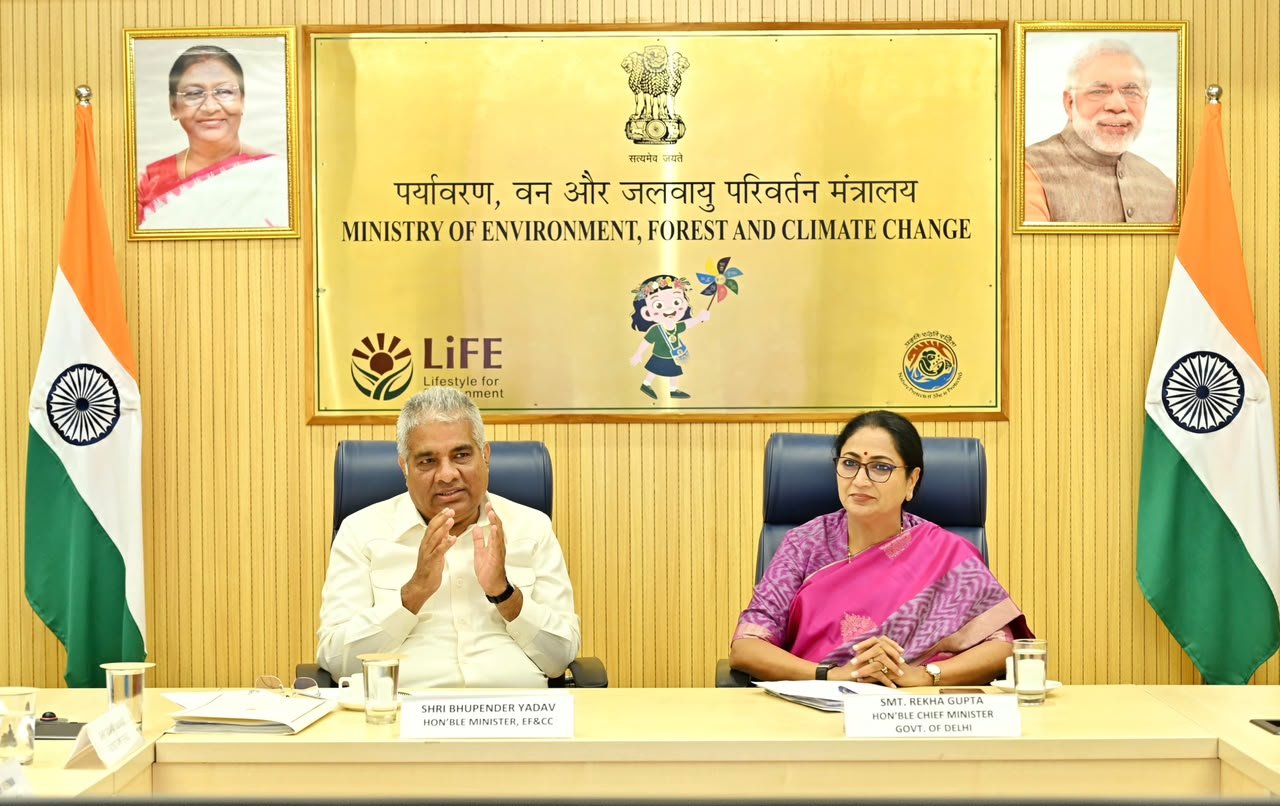
The strategy was finalised during a high-level meeting chaired by Union Minister for Environment, Forest and Climate Change Bhupender Yadav with Delhi Chief Minister Rekha Gupta, where the implementation of the Delhi Government’s Air Pollution Mitigation Action Plan was reviewed ahead of the winter pollution season.
Stricter vehicle restrictions from November 1
As part of advance winter preparedness, the authorities have decided on additional restrictions aimed at reducing emissions from vehicles entering and operating in the capital.
From November 1, 2026, entry into Delhi will be restricted for vehicles registeredoutside Delhi that are below BS-VI emission standards, with CNG and electricvehiclesexempted from the restriction.
The move places vehicular emissions at the centre of the winter pollution-control strategy, particularly as traffic volumes and stagnant winter weather conditions can combine to worsen air quality.
The meeting also decided on a set of additional traffic and mobility measures, including restrictions on polluting vehicles, doubling of parking charges, staggered office timings and 50 per cent work-from-home arrangements.
The measures are intended to reduce vehicle movement and congestion during periods when air pollution levels are expected to deteriorate.
‘No PUCC, No Fuel’ campaign to cover 500 stations
The enforcement of valid Pollution Under Control Certificates (PUCC) has been identified as a key component of the strategy.
Under the ‘No PUCC, No Fuel’ campaign, vehicle owners without a valid PUCC certificate would not be permitted to purchase fuel at designated fuel stations.
The campaign will be implemented across all 500 ANPR-enabled fuel stations in the city. The authorities will combine public awareness with enforcement, while fuel stations that fail to comply with the directions will face action.
The use of Automatic Number Plate Recognition (ANPR) infrastructure is expected to strengthen monitoring and enforcement by enabling authorities to identify and track vehicles more efficiently.
Public Transport First – last mile connectivity: To promote public transport, a city-wide campaign for adoption of the Delhi Metro Sarthi App to be undertaken during October 1–10, including download camps with RWAs and public representatives. It was informed that last-mile connectivity is available at all 228 Metro stations, while Delhi’s bus fleet has reached 6,840, including 5,088 e-buses.
Hotspot Action Plan:For air-quality and traffic hotspots, public representatives would undertake regular field visits with officials, RWAs, traders and traffic police. As on date, 42 hotspots have been rectified, with eight more targeted by October. In consultation with Delhi Traffic Police, one-way traffic and decongestion trials would be undertaken at hotspots. Further, citizens would be encouraged to flag encroachments, illegal parking and dumping points. It was informed by Delhi Government that 8 identified road stretches have been made signal-free and the remaining 7 are targeted for completion by October 2026.
Road Redevelopment and Dust Mitigation: Further directions were given to accelerate road redevelopment with 1,193 km already completed as on date and the balance targeted for completion by November 15. It was also stressed to ensure end-to-end paving of footpaths with focus on walkability and dust mitigation. Complaints are to be closed within 72 hours as per the SOP.
Prevent Open Waste Burning: The meeting decided to intensify deep cleaning, effective waste management and zero-burning measures, including ward-level monitoring, stronger market waste collection and enforcement of Solid Waste Management Rules, 2026. Delhi Government informed that MRSMs have increased to 98 from 76 last year. A city-wide ‘Zero Burning’ pledge campaign would be carried out and dedicated ward- and district/subdivision-level monitoring teams would be deployed by October 15 to prevent waste burning. Further, heating booths would be established on a pilot basis as part of the winter action plan. Special focus would be given to unauthorized regularized colonies and JJ clusters.
Focus on Greening: The meeting laid stress on survival and greening of brown areas. The Delhi Government informed that it has already achieved 71 lakh plantations and greened 433 of 434 acres of identified brown areas.
Waste to Wealth: The meeting laid stress on making registrations on the Malba App as a mandatory condition for building plan sanction. The Delhi Government informed that for construction and demolition dust control, a ban would be in force on dust generating demolition activity and outdoor civil construction activity from November 1 to January 31, with a complete ban on construction and demolition activities from December 10 to January 20.
Winter Protocol: Advance winter measures were decided during the meeting that include restrictions on polluting vehicles, doubled parking charges, staggered office timings and 50 per cent work-from-home arrangements. It was also decided to restrict entry of all vehicles registered outside Delhi and below BS-VI emission standards, except CNG and EV vehicles, with effect from 01.11.2026.
Parivartan Yojana and EV Outreach:The meeting decided to promote EV Policy 2026, increasing incentives for scrapping old vehicles and a mission-mode registration drive for Parivartan Scheme. It was further directed to run Jan Bhagidari Camps in October-November to expedite the drive.
Mitigating Industrial Pollution: Decision was taken to strengthen industrial enforcement, operationalise an AI-enabled Command and Control Centre, increase monitoring stations from 47 to 60, and deploy 334 enforcement teams to enforce strict action against non-conforming polluting industries. Citizen participation, grievance redressal, daily AQI bulletins and coordinated NCR-level airshed action will be further strengthened.
Addressing the meeting, Union Minister Bhupender Yadav called for organising Jan Bhagidari events at the 37 identified hotspots in Delhi by October 10, involving relevant stakeholders. He directed that actionable points be identified for each hotspot and their implementation closely monitored.
“Public representatives would be visiting these hotspots and reviewing the implementation of air pollution mitigation measures on the ground. These area-specific interventions” he said.
The Minister also stressed the need for coordinated action to address pollution from agricultural activities, including through a meeting with the Union Agriculture Minister and the Agriculture Ministers of the NCR States. Mr Yadav called for converting the discussions held with Delhi and other NCR authorities into concrete action points, with the action plans for NCR areas to be finalised before October 10.
Chief Minister of Delhi Rekha Gupta said the Delhi Government has undertaken several measures to improve air quality and stressed the need to ensure that decisions taken and action points identified translate into effective implementation on the ground.
The CM called for stronger coordination among agencies, particularly in enforcement and traffic management, and greater use of technology, including cameras at construction sites, to monitor compliance.