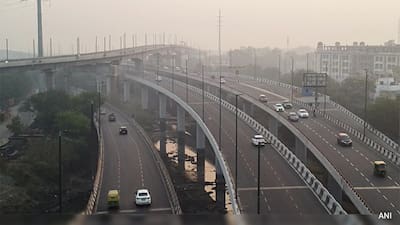
New Delhi: Delhi’s air quality deteriorated to the ‘poor’ category on Wednesday, prompting the Commission for Air Quality Management (CAQM) to implement Stage-I measures under the Graded Response Action Plan (GRAP) across the National Capital Region (NCR) with immediate effect.
According to the CAQM order, Delhi’s Air Quality Index (AQI) rose from 179 in the ‘moderate’ category on October 20 to 244 by 2 pm on October 21. The sharp increase signals the worsening pollution situation as the national capital moves deeper into the winter pollution season.
Under the GRAP framework, Stage-I measures are triggered when the AQI falls in the ‘poor’ category, ranging from 201 to 300. The measures are intended to curb emissions from major pollution sources before air quality deteriorates further.
The CAQM’s directions call for intensified dust-control measures at construction sites and roads, stricter enforcement of pollution-control norms, effective management of construction and demolition waste, and action against visibly polluting vehicles and other emission sources. Authorities are also expected to strengthen inspections and public awareness efforts to ensure compliance.
Winter pollution: A recurring challenge
Delhi’s deteriorating air quality is part of a recurring seasonal pattern. Pollution levels typically worsen during October and November as temperatures fall, wind speeds weaken and atmospheric conditions become less favourable for the dispersion of pollutants. Smoke from agricultural residue burning in neighbouring states can add to the pollution load, alongside emissions from vehicles, construction activities, road dust, industries and waste burning.
The problem is not confined to Delhi. The wider NCR, including neighbouring urban and industrial areas, shares interconnected pollution sources, making coordinated action across state and municipal boundaries essential.
What Stage-I GRAP means
GRAP is a graded emergency response mechanism designed to introduce progressively stricter pollution-control measures as air quality worsens. Stage-I applies to the ‘poor’ AQI category of 201–300, while Stage-II covers ‘very poor’ air quality of 301–400, Stage-III applies to ‘severe’ air quality of 401–450, and Stage-IV is triggered when the AQI exceeds 450.
The plan is intended to ensure that preventive and enforcement measures begin before pollution reaches emergency levels. However, its effectiveness depends on timely implementation, sustained monitoring and action against the sources responsible for emissions.
With Delhi’s AQI reaching 244 on Wednesday afternoon, the immediate priority is to prevent further deterioration. The coming days will be critical in determining whether the initial measures can contain pollution or whether the city will need to move to stricter stages of the response plan.