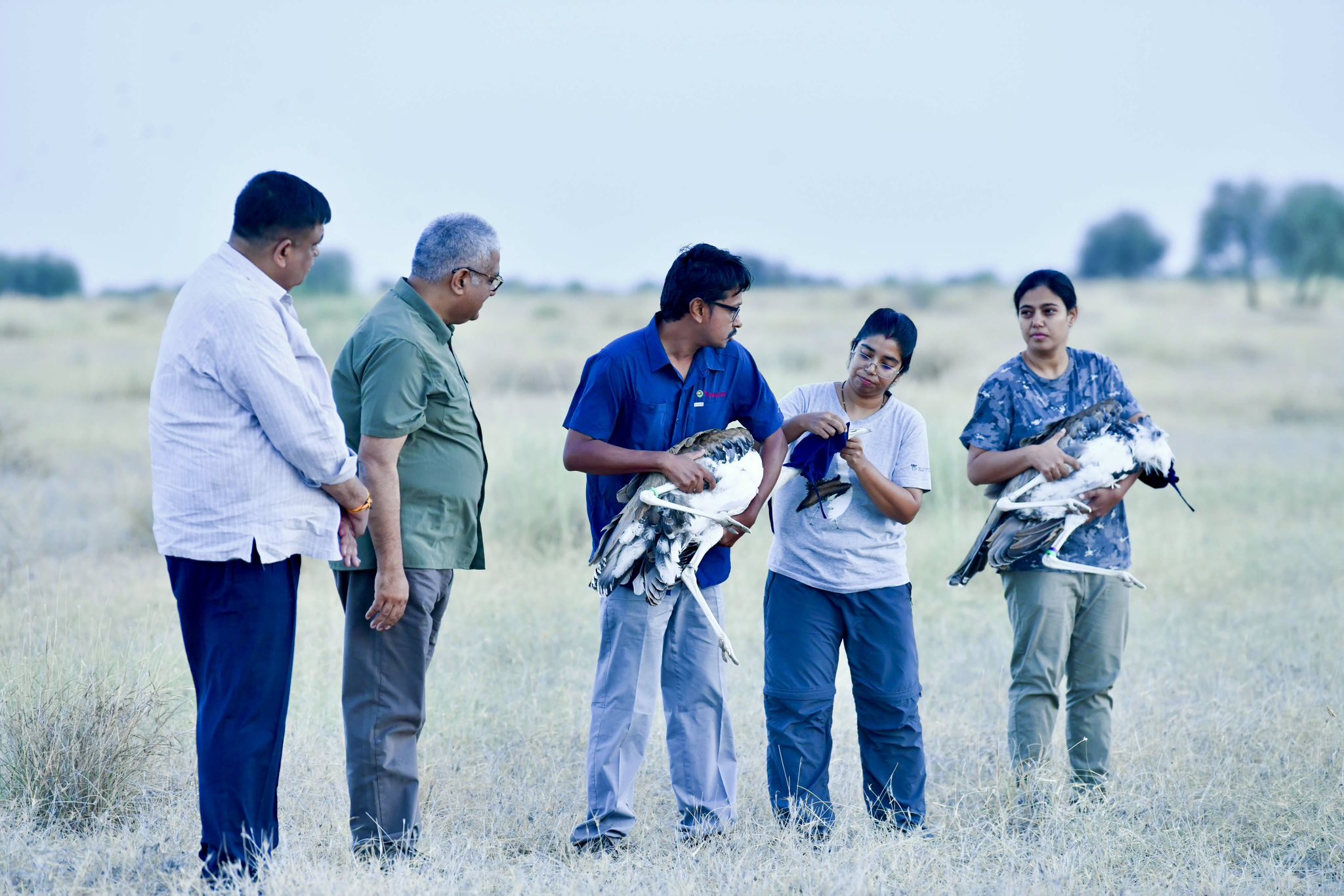
Jaisalmer: In a major boost to efforts to save the critically endangered Great Indian Bustard (GIB), Union Environment, Forest and Climate Change Minister Bhupender Yadav today released two male Great Indian Bustards into the wild at Sam in Rajasthan’s Desert National Park, marking a significant shift in India’s conservation strategy from captive breeding to rewilding and population recovery in the species’ natural habitat.
Rajasthan Minister for Forest and Environment Sanjay Sharma, along with senior officials from the Union and Rajasthan governments, was present during the release.
The move represents a crucial new phase in the country’s Great Indian Bustard conservation programme, nearly a decade after scientists began systematically building a viable conservation-breeding population of the species.
In a post on X, Yadav thanked Prime Minister Narendra Modi for his continued guidance, encouragement and support in enabling scientists and conservation agencies to work towards the recovery of the Great Indian Bustard and other endangered species.
The Environment Minister said the release was the result of nearly a decade of sustained efforts by scientists, researchers and ground staff working to help the Great Indian Bustard reclaim its desert habitat in Rajasthan.
From captive breeding to rewilding
The release of the two birds marks an important transition in the Bustard Recovery Programme. The immediate focus of the conservation-breeding initiative was to establish a healthy population under controlled conditions. The programme is now moving towards carefully monitored releases into the birds’ natural habitat.
Officials and scientists will closely monitor the released birds to assess their adaptation, movement, survival and behaviour in the wild. The experience gained from this first release will be used to refine protocols for future releases.
The strategy is particularly significant for the Great Indian Bustard, one of India’s most threatened grassland birds and a species whose remaining population is concentrated largely in the arid landscapes of Rajasthan and Gujarat.
97 GIBs housed at breeding facilities
The conservation-breeding programme has made substantial progress over the past few years.
The Great Indian Bustard conservation-breeding facilities at Sam and Ramdevra in Rajasthan currently house 97 birds. Of these, 40 originated from eggs collected from the wild, while 57 were bred in captivity.
At present, 86 birds are being maintained for captive reproduction, while 11 have been earmarked for release into the wild. Two of these 11 birds were released at Desert National Park on Sunday.
The captive-breeding programme produced 24 live chicks in 2025 and 29 chicks in 2026, strengthening the foundation for a long-term recovery programme.
Scientists use ‘jumpstart’ technique
Scientists have also developed innovative interventions to improve the chances of GIB recovery. One such intervention is the novel ‘jumpstart’ approach, under which captive-laid eggs are placed in wild nests. The eggs were accepted by incubating female Great Indian Bustards, resulting in the successful hatching of six chicks in Rajasthan and two in Gujarat.
The technique could provide an additional tool for strengthening wild populations while reducing dependence solely on captive breeding.
200 sq km of grassland identified as key habitat
Alongside breeding and rewilding, habitat restoration remains a central component of the recovery strategy.
The Rajasthan Forest Department has established around 200 sq km of fenced grassland enclosures inside the Desert National Park. Long-term telemetry studies conducted by the Wildlife Institute of India (WII) have identified these areas as prime breeding habitats for the Great Indian Bustard.
The protected grasslands are intended to provide safer breeding and foraging conditions while reducing threats to the species and improving habitat quality.
Multi-agency programme for GIB recovery
The Bustard Recovery Programme is a collaborative initiative involving the Ministry of Environment, Forest and Climate Change, Rajasthan Forest Department and Wildlife Institute of India.
The programme also has technical collaboration from the International Fund for Houbara Conservation and receives funding support from National CAMPA.
Its approach goes beyond captive breeding and includes habitat management, habitat restoration, threat mitigation, community engagement and scientific monitoring.
The conservation strategy is also being implemented in accordance with the Supreme Court of India’s judgment and recommendations of the Expert Committee constituted for the purpose.
The release of the two male Great Indian Bustards therefore marks more than the return of two birds to the desert. It is the beginning of a closely monitored attempt to rebuild a self-sustaining wild population of one of India’s most endangered birds—and to test whether years of captive breeding and scientific intervention can ultimately translate into recovery in the wild.