

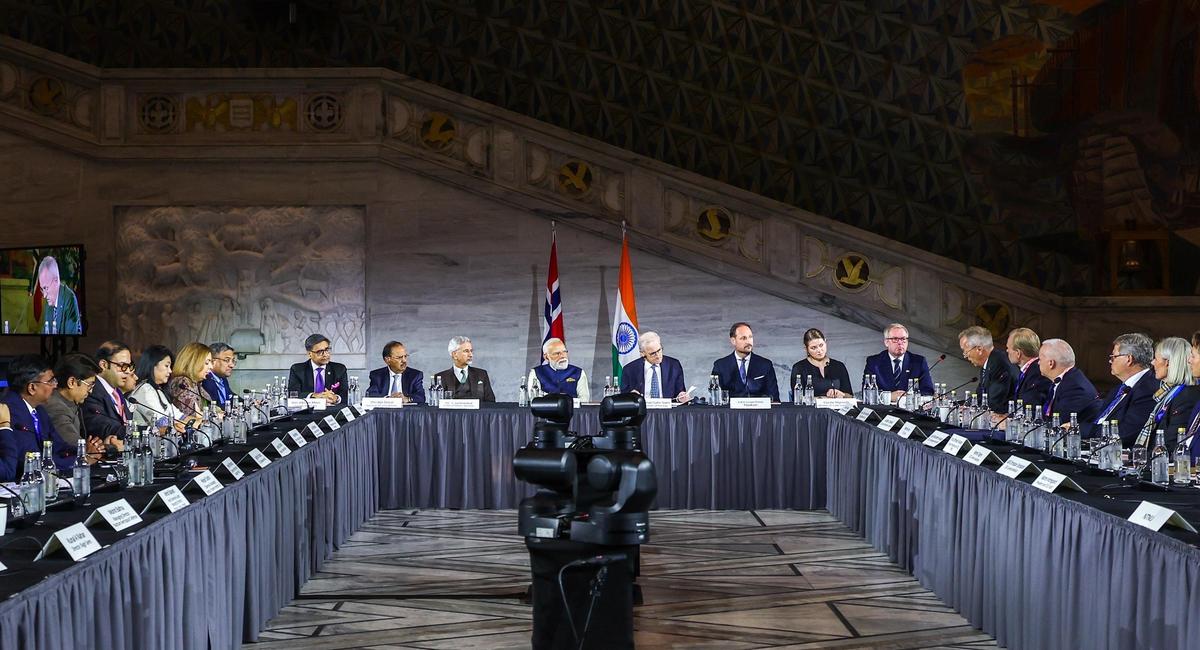
Oslo:- India and Norway Monday announced the elevation of bilateral ties to a Green Strategic Partnership, marking a major step in strengthening cooperation between India and Norway in sustainability, renewable energy, climate action and green growth.
The decision was taken during bilateral talks held in Oslo between Prime Minister Modi and Prime Minister of Norway, H.E. Mr. Jonas Gahr Støre.
Prime Minister Modi, who is on five nations tour, was warmly received by Prime Minister Støre, and the two leaders reviewed the full spectrum of India-Norway relations, including climate action, energy transition, blue economy, ocean governance, Arctic cooperation and emerging technologies.
Both sides emphasized the importance of strengthening collaboration in areas that support sustainable development and environmentally responsible growth.
Focus on Sustainability and Green Growth
The newly announced Green Strategic Partnership reflects the two nations’ shared commitment to achieving sustainable development and accelerating the transition toward cleaner energy systems. During the talks, the leaders emphasized expanding collaboration in areas such as:
- Climate action and energy transition
- Renewable and clean energy
- Blue economy and ocean governance
- Arctic and polar cooperation
- Research, innovation, and emerging technologies
Both countries identified strong opportunities for cooperation in advanced green technologies including carbon capture, utilization and storage (CCUS), offshore wind energy, and sustainable industrial solutions.
Prime Minister Modi invited greater Norwegian investment in India’s fast-growing clean energy sector, while Norway expressed interest in supporting India’s green transformation through technology partnerships and long-term investments.
During the talks, the leaders highlighted the growing scope for cooperation in renewable energy and green technologies. They called for deeper collaboration in niche sectors such as carbon capture, utilization and storage (CCUS), offshore wind energy and clean energy innovation.
Norway also expressed interest in expanding investments in India’s clean energy sector, while India welcomed greater participation of Norwegian companies in its green growth initiatives.
The two countries agreed to strengthen cooperation in Arctic and polar research and logistics, reaffirming their commitment to environmentally responsible practices in sensitive polar regions.
They also stressed the importance of joint work in research and innovation, including renewable energy, climate science, oceans, health, critical minerals, information technology and other emerging technologies.
Economic and commercial cooperation also figured prominently during the meeting. The leaders agreed that there remains significant untapped potential in bilateral trade and investment.
They underlined the shared objective of doubling the current value of trade between India and Norway by 2030 and encouraged businesses from both countries to forge stronger partnerships across sectors.
The leaders also referred to the investment commitment of USD 100 billion under TEPA and the goal of creating one million jobs in India through expanded economic cooperation.
The Green Strategic Partnership between India and Norway is expected to serve as a comprehensive framework for cooperation in sustainable development and climate-focused growth.
The partnership will focus on accelerating the transition to clean energy, promoting green technologies, strengthening maritime and blue economy cooperation, supporting climate action initiatives and boosting environmentally sustainable investments.
For India, the partnership offers opportunities to access advanced Norwegian expertise in offshore energy, carbon management and maritime sustainability, while attracting investments for its rapidly growing green economy.
For Norway, India represents an important strategic partner and one of the world’s fastest-growing markets for renewable energy and sustainable infrastructure.
The announcement reflects the growing alignment between the two countries on global environmental priorities and highlights their shared commitment to building a greener and more sustainable future through innovation, technology and long-term economic cooperation.



I wish I had read this sooner!