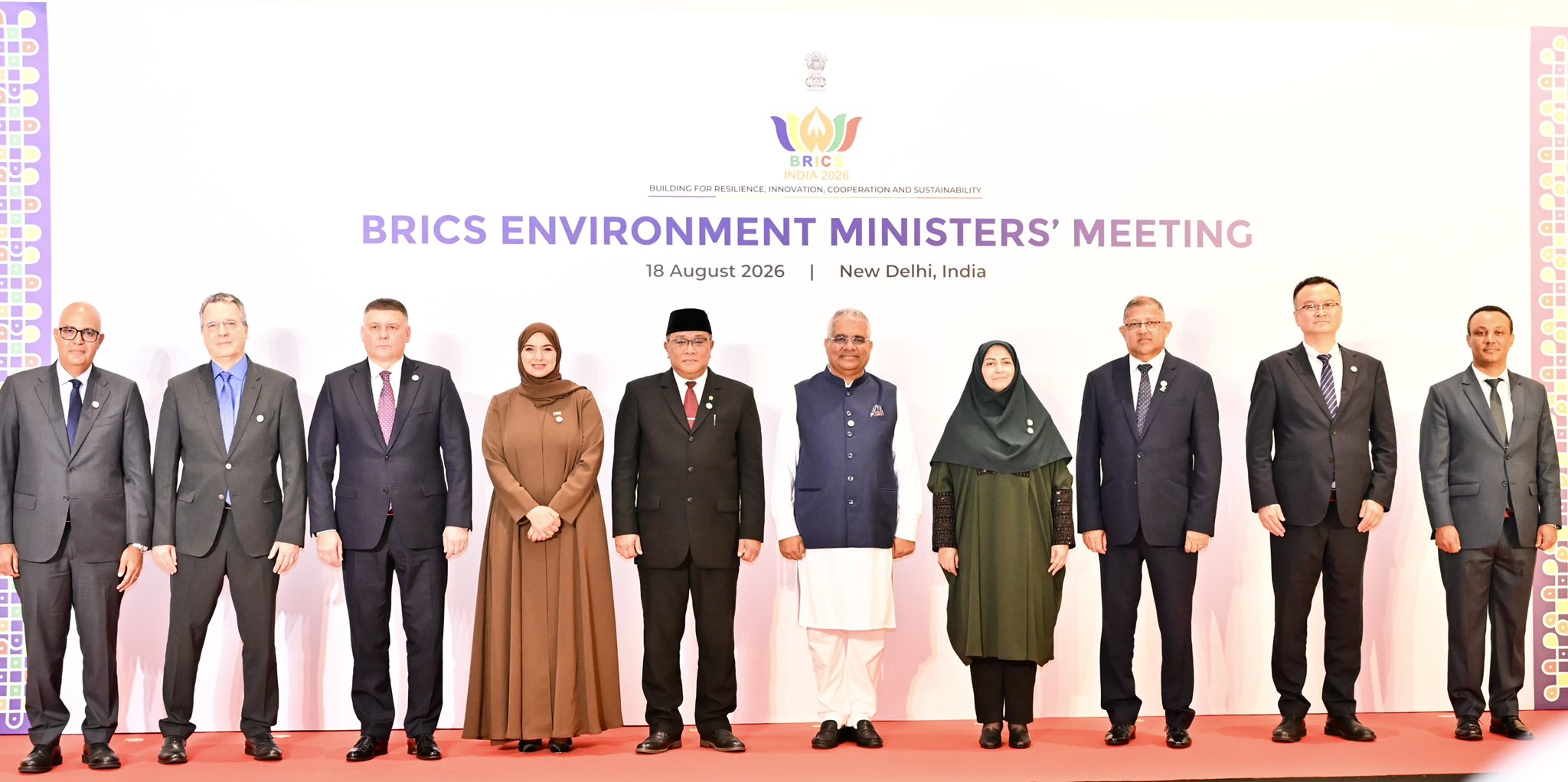
New Delhi:- The 12th BRICS Environment Ministers’ Meeting, held under India’s BRICS Chairship 2026, concluded in New Delhi with the consensual adoption of a Joint Ministerial Statement (JMS) and the launch of four knowledge compendiums, marking a renewed push by the grouping of major emerging economies for collective action on climate change, biodiversity loss, pollution, land degradation and disaster risks.
The meeting brought together Environment Ministers and Heads of Delegations from BRICS member countries to strengthen cooperation on environmental challenges that increasingly cut across national boundaries. The outcomes underline the growing importance of BRICS as a platform for developing countries to share technology, knowledge, finance, traditional practices and institutional capacity to build climate and ecological resilience.
Union Minister for Environment, Forest and Climate Change Bhupender Yadav, addressing the meeting, said India’s BRICS Chairship is guided by Prime Minister Narendra Modi’s vision of placing the concerns of the Global South at the forefront of international cooperation.
He described the new BRICS vision as “Building Resilience and Innovation for Cooperation and Sustainability”, centred on a people-first approach and the principle of “Humanity First.”
HMEFCC Shri @byadavbjp addressed the 12th BRICS Environment Ministers’ Meeting, welcoming Ministers and Delegates and highlighting the importance of aligning policy, technology and public participation towards building a sustainable planet.
— MoEF&CC (@moefcc) August 18, 2026
The discussions reaffirmed a “humanity… pic.twitter.com/mFQMxi4z2B
Four key outcomes
The Joint Ministerial Statement comprises four major outcome documents aimed at translating BRICS cooperation into practical environmental action.
These include the Terms of Reference for a Network of BRICS Institutions to Advance Knowledge Sharing, Research and Innovation in Sustainable Lifestyles, which seeks to build stronger institutional links among BRICS countries and promote research and exchange of experiences on sustainable consumption and lifestyles.
The second outcome is the BRICS Principles for Integrated Landscape Management for Combating Desertification, Sustainable Land Management and Ecosystem Resilience. The framework recognises that land degradation, desertification, biodiversity loss and climate vulnerability are interconnected challenges requiring landscape-level approaches rather than isolated interventions.
The third outcome, the Common Understanding for Forest Fire Preparedness and Response across BRICS, focuses on strengthening cooperation in forest-fire prevention, preparedness, early warning, response and post-fire recovery.
The fourth is the BRICS Principles for Advancing Climate Resilience through People-centric and Community-based Adaptation built on Traditional Knowledge. It places local communities and indigenous and traditional knowledge at the centre of adaptation strategies while seeking to combine such knowledge with modern science.
BRICS cooperation crucial as environmental risks grow
The significance of the meeting goes beyond the four documents. BRICS countries collectively represent a substantial share of the world’s population, land area, economic activity and natural resources. Their economies are also experiencing rapid urbanisation, industrialisation and infrastructure development, making environmental cooperation increasingly important.
Climate change, extreme weather, forest fires, water stress, land degradation, biodiversity loss and pollution are affecting developing economies simultaneously. For many countries of the Global South, these challenges are closely linked with poverty reduction, food security, livelihoods, energy security and economic development.
This makes BRICS particularly important as a platform where emerging economies can develop solutions suited to their own circumstances rather than relying exclusively on approaches developed in advanced economies.
Cooperation among BRICS nations can help expand access to affordable environmental technologies, strengthen early-warning systems, improve disaster preparedness, promote climate-resilient agriculture and infrastructure, accelerate circular-economy practices and support restoration of degraded ecosystems.
It can also provide a mechanism for sharing experiences on how environmental protection can be integrated with economic development.
India puts people and communities at the centre
In his address, Yadav stressed that environmental protection and development should not be viewed as competing objectives.
“Ecological restoration and human development can advance together,” he said, highlighting initiatives such as Mission LiFE and Ek Ped Maa Ke Naam as examples of combining ecological restoration with public participation and community ownership.
The Minister also emphasised the importance of combining traditional knowledge with modern science so that environmental solutions are “scientifically robust, locally relevant and socially inclusive.”
This approach is particularly relevant for BRICS countries, where millions of people depend directly on forests, agriculture, fisheries, grasslands and other ecosystems for their livelihoods.
Four priorities of India’s BRICS Chairship
India has placed four broad environmental priorities at the centre of its BRICS Chairship: Sustainable lifestyles; afforestation, forest-fire management and disaster resilience; circular economy; and climate adaptation.
Yadav said these priorities reflect the conviction that environmental action must remain people-centric, sustainable, implementation-oriented and responsive to the realities of developing countries.
The focus on sustainable lifestyles is significant as BRICS economies are experiencing rapid growth in consumption and resource demand. Cooperation on resource efficiency, sustainable production, waste reduction and responsible consumption could help countries pursue economic growth while reducing pressure on natural resources.
The circular economy agenda is similarly important for BRICS economies facing growing volumes of municipal waste, plastic pollution, electronic waste, construction waste and industrial waste. Sharing technologies and business models for recycling, reuse, repair and resource recovery could create economic opportunities while reducing environmental pressures.
Forest fires emerge as a shared threat
Forest fires have become an increasingly serious concern across many parts of the world, with climate change, prolonged heatwaves, drought and changing land-use patterns increasing the risk and intensity of fires.
The new BRICS common understanding on forest-fire preparedness and response provides an opportunity for member countries to exchange experience on satellite monitoring, early-warning systems, firefighting technologies, community preparedness and post-fire ecological restoration.
For countries with large forest landscapes, cooperation could also improve regional capacity to anticipate fire risks and strengthen coordination between scientific institutions, governments and local communities.
Adaptation and climate finance remain critical
The meeting also highlighted the urgent need to strengthen climate adaptation, particularly in developing countries. While mitigation remains essential to limit future warming, communities are already dealing with floods, droughts, heatwaves, cyclones, wildfires, water scarcity and other climate-related risks.
Community-based adaptation can help ensure that climate policies respond to local realities. The inclusion of traditional knowledge in the BRICS principles could also strengthen resilience in communities that have historically developed methods of managing water, forests, agriculture and natural hazards.
India also highlighted its new Nationally Determined Contribution for 2031–2035, presenting it as part of the country’s broader commitment to climate action while maintaining inclusive development and energy security.
Mr Yadav said the outcomes of India’s BRICS Chairship were the result of months of dialogue, negotiation and collaboration among member countries.
He called for BRICS to move beyond declarations and convert cooperation into practical capabilities through knowledge networks, technical exchanges, training, technology cooperation and stronger institutional partnerships.
This implementation focus could prove particularly important because environmental challenges often require large investments and long-term institutional capacity. Cooperation among BRICS countries can potentially reduce the cost of technology deployment, facilitate South-South knowledge exchange and create new partnerships between governments, research institutions, businesses and communities.
The four knowledge compendiums launched alongside the meeting are expected to further strengthen this knowledge-sharing approach.
A stronger Global South environmental voice
The New Delhi meeting comes at a time when developing countries are seeking greater influence in global climate and environmental decision-making, particularly on issues of climate finance, adaptation, technology transfer, capacity building and equitable development.
BRICS can provide a collective platform for these countries to articulate common priorities while also developing practical solutions among themselves.
The environmental agenda is therefore becoming an important part of the wider BRICS cooperation framework. Its relevance extends from climate change and biodiversity to energy, agriculture, water, waste management, disaster preparedness and sustainable economic growth.
The challenge now will be to translate the commitments adopted in New Delhi into measurable action on the ground. As Yadav stressed, the objective is to build resilience without leaving communities behind, pursue innovation with responsibility and place sustainability at the centre of development.