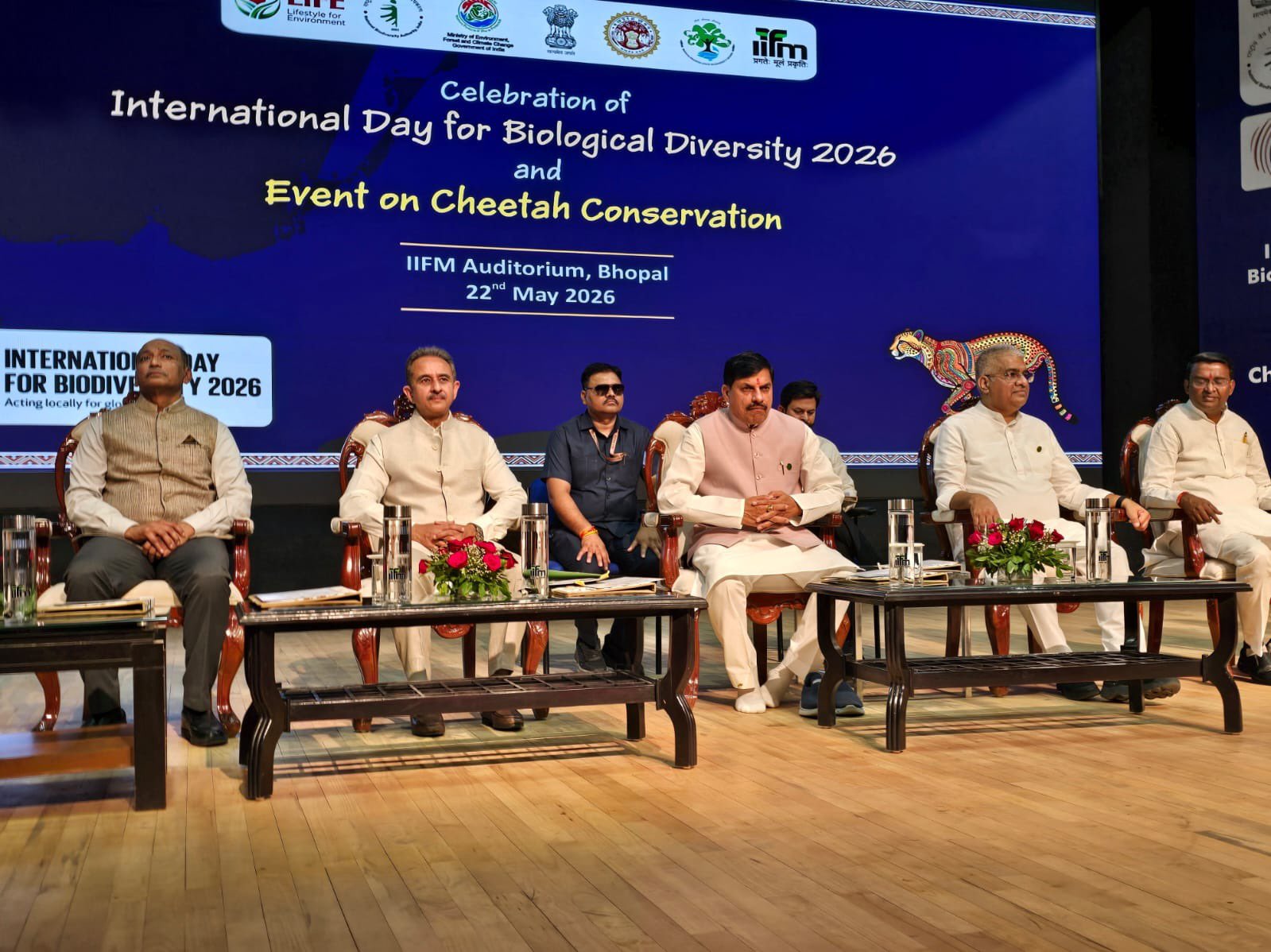
Bhopal: Environment Minister Bhupender Yadav and Chief Minister of Madhya Pradesh Mohan Yadav on Friday presided over the national-level celebrations of the International Day for Biological Diversity (IDB) 2026 at the Indian Institute of Forest Management in Bhopal, where the spotlight remained on biodiversity conservation, community participation and the progress of Project Cheetah.
Organised by the Ministry of Environment, Forest and Climate Change in collaboration with the Government of Madhya Pradesh, National Biodiversity Authority and the International Big Cat Alliance, the event was held under the theme, “Acting Locally for Global Impact.”
Addressing the gathering, Chief Minister Mohan Yadav said Madhya Pradesh had emerged as a leading centre for biodiversity conservation and wildlife protection in the country.
“Madhya Pradesh, recognised as the ‘Tiger State of India’, has strengthened its ecological identity through conservation of forests, wetlands and river ecosystems that support both biodiversity and livelihoods,” he said.
Highlighting the significance of Project Cheetah, the Chief Minister described the reintroduction of cheetahs in the state as “a landmark achievement in India’s conservation journey and a symbol of ecological restoration and biodiversity recovery.”
He added, “Project Cheetah has strengthened habitat conservation, scientific wildlife management and community participation in conservation efforts.”
Union Environment Minister Bhupender Yadav said the theme of IDB 2026 underscored the need for strong local action to achieve global environmental goals.
“Meaningful global outcomes can emerge only through strong local action, community participation and sustainable lifestyles,” the minister said.
Emphasising India’s ecological wealth, Yadav noted that the country’s biodiversity ranges from the Himalayas and forests to wetlands, grasslands, deserts and marine ecosystems.
“Community-led conservation traditions such as sacred groves, folk varieties and local stewardship practices reflect the deep cultural and ecological relationship between people and nature,” he said.
The minister also underlined the shift in conservation thinking from protecting individual species to preserving interconnected ecosystems.
“Plants and animals cannot survive in isolation, but depend upon complex and interdependent ecological systems. Conserving biodiversity strengthens nature’s resilience against climate change,” he said.
Reaffirming India’s commitment to the Convention on Biological Diversity and the Kunming-Montreal Global Biodiversity Framework, Yadav said the Biological Diversity Act, 2002 had created a decentralised institutional framework through Biodiversity Management Committees (BMCs), State Biodiversity Boards and the National Biodiversity Authority.
He further said amendments to the Biological Diversity Act and related rules had created a more conducive environment for industries while ensuring benefits reach local communities.
“Nearly Rs 145 crore has been released under the Access and Benefit Sharing mechanism, benefiting around 11,000 Biodiversity Management Committees across the country,” he said, urging Madhya Pradesh to further empower village-level BMCs.
Referring to Project Cheetah, launched in 2022, the minister said the initiative reflected India’s commitment to ecological restoration and grassland conservation.
“The successful adaptation and breeding of cheetahs in India represent encouraging progress in long-term species recovery and habitat restoration efforts,” he added.
Kirti Vardhan Singh also addressed the gathering and stressed the connection between biodiversity conservation and sustainable development.
“Biodiversity conservation is intrinsically linked to food security, water security, livelihoods, climate resilience and sustainable development,” he said.
He added that India’s traditional ecological wisdom and the global movement of Lifestyle for Environment (LiFE) could play a key role in strengthening environmental protection efforts.