By TheEnvironment.in
New Delhi:- A catastrophic flash flood that struck the Nepal-Tibet border on August 26 has brought a growing Himalayan threat into sharp focus, as the region warms, melting and destabilising glaciers are creating new and potentially devastating hazards for communities living downstream.
The disaster was initially believed to have been triggered by an earthquake. But subsequent analysis by the U.S. Geological Survey (USGS) indicates that the seismic signal was actually generated by aglacial collapse and debris flow, rather than by an earthquake triggering the disaster. The collapse sent ice, rock, snow, mud and debris rushing into the valley and produced a powerful flash flood downstream.
The distinction is important. An earthquake is a geological event that can occur independently of climate change. A collapsing glacier, however, raises a much larger question: how is a rapidly warming Himalaya changing the stability of the world’s highest mountain region?
According to preliminary satellite analysis reported by scientists, a large section of glacier ice collapsed from high in the mountains, dropping roughly 1.2 kilometres vertically into the valley. The collapse generated a seismic signal that was initially interpreted as an earthquake. USGS later concluded that the event was a glacial collapse followed by a debris flow and catastrophic impacts downstream.
The resulting torrent travelled through the mountain river system, carrying enormous quantities of ice, rock, sediment and water.
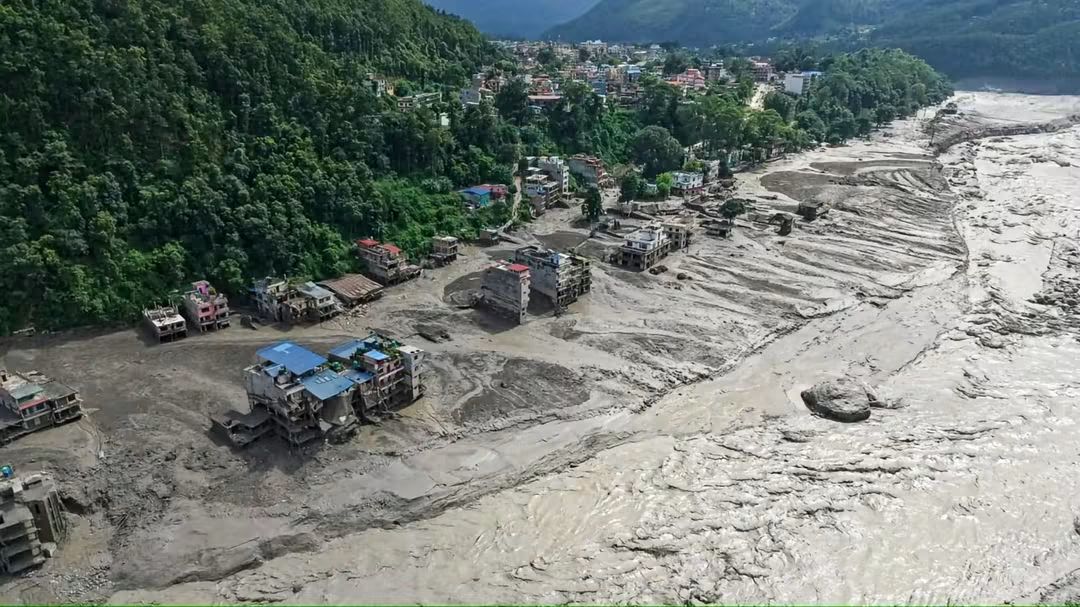
The sudden surge overwhelmed communities and infrastructure along the valley. Roads and bridges were destroyed, homes were swept away and critical infrastructure was damaged. The disaster also severely affected the Gyirong border area and disrupted transport and communications between Nepal and Tibet.
The latest reports indicate that the human toll has risen sharply, with hundreds dead and more than a thousand people reported missing as rescue operations continue.
Because the disaster occurred in steep, remote mountain terrain, damaged roads and bridges are making rescue and relief operations particularly difficult.
Was climate change responsible?
Scientists have not established that climate change directly caused this particular glacier collapse. That distinction is crucial.
The immediate trigger was the collapse of a glacier and associated debris flow. Researchers are still investigating the precise physical mechanisms that caused the ice mass to fail. But the disaster occurred against a well-established background of rapid climate change in the Hindu Kush Himalaya.
The International Centre for Integrated Mountain Development (ICIMOD) reported in 2026 that glaciers across the Hindu Kush Himalaya are melting at an accelerating rate, with ice-loss rates doubling since 2000. Between 1990 and 2020, the region’s glaciers lost approximately 12% of their total area and 9% of their estimated ice reserves.
That means climate change may not necessarily be described as the single cause of the Nepal-Tibet disaster, but it is changing the physical conditions under which such disasters occur.
Glaciers are not simply frozen rivers of ice. They are part of a complex mountain system involving snow, rock, water, permafrost and steep slopes. When temperatures rise, that system begins to change.
Higher temperatures cause glaciers to lose mass more rapidly. As ice retreats, the geometry and stability of mountain slopes can change.
ICIMOD’s latest assessment says glacier wastage in the Hindu Kush Himalaya has doubled since 2000, while some monitored glaciers have lost up to 27 metres of ice thickness since 1975.
Glaciers and permanently frozen ground help bind high mountain landscapes together. As ice melts and permafrost thaws, slopes can become increasingly unstable. That can increase the likelihood of rockfalls, landslides, avalanches and ice-rock avalanches.
ICIMOD warns that glacier retreat and permafrost thaw can alter slope stability and increase cascading hazards, including landslides, floods and enhanced erosion.
When glaciers retreat, meltwater can accumulate behind natural dams made of ice, rock and sediment. These lakes can become dangerous reservoirs.
If a natural dam fails, enormous quantities of water can suddenly rush downstream in what is known as a Glacial Lake Outburst Flood (GLOF).
Importantly, the Nepal-Tibet event is being described as a glacial collapse and debris-flow event, not necessarily as a conventional GLOF. But both hazards are part of the increasingly complex risk landscape created by a warming cryosphere.
This is why scientists increasingly describe Himalayan disasters as multi-hazard events rather than isolated floods or landslides.
ICIMOD has warned that climate change is making hazards in the Hindu Kush Himalaya increasingly interconnected, with floods, landslides, GLOFs and other events capable of triggering or amplifying one another.
The Himalayas are losing their ice faster
The scale of the underlying transformation is enormous. The Hindu Kush Himalaya contains some of the world’s most important mountain glaciers and is often called the “Water Towers of Asia” because its snow and ice contribute to river systems supporting nearly two billion people downstream. ICIMOD estimates that glaciers in the region have already experienced substantial reductions in area and ice reserves.
The changes are not occurring uniformly. Some of the greatest percentage losses have been recorded in parts of the eastern and central Himalayas and the Tibetan mountain region.
Scientists warn that continued warming could push parts of the Himalayan cryosphere towards critical thresholds beyond which some changes become difficult or impossible to reverse.
Previous assessments have projected that Himalayan glaciers could lose 30–50% of their volume by 2100 even if global warming is limited below 2°C.
Why the disaster is a warning for India too
The Nepal-Tibet disaster should not be viewed as an isolated Himalayan tragedy. India shares the same mountain system and faces many of the same risks.
The Indian Himalayas contain thousands of glaciers and numerous glacial lakes. Communities, roads, hydropower projects, tourism centres and strategic infrastructure are increasingly exposed to rapidly changing mountain hazards.
A collapse high in the mountains can generate consequences hundreds of kilometres downstream. The lesson from Nepal is therefore not simply that glaciers are melting. It is that a changing glacier can change the behaviour of an entire river basin.
ICIMOD has emphasised that better forecasting and locally adapted early-warning systems can save lives in the Hindu Kush Himalaya, particularly as multi-hazard events become more complex.
The challenge is particularly difficult because Himalayan river basins cross political boundaries. A hazard developing in Tibet can rapidly affect Nepal, India or Bangladesh downstream.
The bigger climate message
The Nepal-Tibet flash flood is a reminder that climate change is not simply about hotter summers or changing rainfall.
In mountain regions, warming can fundamentally alter the stability of the landscape. A glacier that has existed for centuries can retreat. A frozen slope can thaw. A glacial lake can expand. A mountain face can become unstable. An avalanche can block a river. And a sudden release of water, ice and debris can transform a quiet mountain valley into a destructive torrent within minutes.
The precise cause of the August 26 collapse remains under investigation. Scientists should therefore be cautious about declaring climate change the direct cause of this particular event.
The Himalayas are warming, glaciers are shrinking faster, and the risks associated with a changing cryosphere are increasing. The Nepal-Tibet disaster therefore represents more than a devastating flash flood. It is a warning about what happens when climate change begins to destabilise the frozen infrastructure of the world’s highest mountains.
For governments across the Himalayan region, the message is increasingly urgent: cutting greenhouse-gas emissions remains essential, but adaptation can no longer wait.
The region needs better glacier monitoring, stronger early-warning systems, climate-resilient infrastructure, hazard-sensitive development and coordinated management of transboundary river basins.