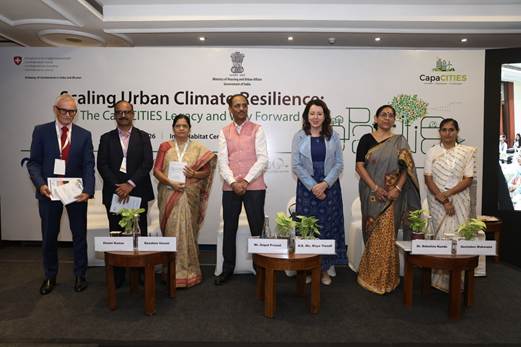
New Delhi:- The CapaCITIES programme, which has supported Indian cities in integrating climate action into urban planning over the past decade, marked its 10-year journey with a national event titled Scaling Urban Climate Resilience: The CapaCITIES Legacy and Way Forward at the India Habitat Centre in New Delhi.
Organised by ICLEI South Asia and the National Institute of Urban Affairs (NIUA), the event brought together senior government officials, mayors, municipal commissioners, engineers, representatives from more than 30 cities, six state governments, financial institutions and climate experts to discuss the next phase of climate-resilient urban development in India.
Launched in 2016 with support from the Embassy of Switzerland to India and Bhutan, the CapaCITIES programme has focused on building the capacity of urban local bodies to mainstream low-carbon and climate-resilient development into city planning.
The initiative has worked with cities including Ahmedabad, Rajkot, Vadodara, Udaipur, Siliguri, Coimbatore, Tiruchirappalli and Tirunelveli, while also supporting the governments of Gujarat and Tamil Nadu. The programme contributes to India’s target of achieving net-zero emissions by 2070.
Addressing the inaugural session, Economic Adviser in the Ministry of Housing and Urban Affairs Gopal Prasad said climate action must be institutionalised within city governance through dedicated climate cells and stronger integration with urban planning systems. He said the model developed under the CapaCITIES programme could be replicated across the country.
Swiss Ambassador to India and Bhutan Maya Tissafi highlighted the decade-long partnership between India and Switzerland, saying the programme had strengthened institutions and enabled city governments to integrate climate considerations into planning and budgeting.
NIUA Director Dr Debolina Kundu said the initiative had demonstrated that climate action could generate multiple developmental benefits, including livelihood generation, women’s empowerment, ecosystem restoration and emissions reduction. She said cities that have successfully implemented projects under the programme could serve as models for others across the country.
ICLEI South Asia Executive Director Emani Kumar said the programme supports the Prime Minister’s Panchamrit commitments and complements national initiatives such as Mission LiFE, the Smart Cities Mission and AMRUT. He described the event as the beginning of a new phase aimed at scaling climate-resilient and future-ready urban development.
The event also featured technical sessions on integrating climate action into urban planning, mobilising finance for sustainable infrastructure and expanding successful city-led initiatives.
Three knowledge products, including a Net-Zero Climate Resilient Cities Methodology Toolkit, an energy transition guidebook for urban local bodies and a white paper on climate finance, were launched.
A video training series on preparing Net-Zero Climate Resilient City Action Plans was also released on the National Urban Learning Platform. An exhibition showcasing the programme’s impact across participating cities was organised alongside the event.