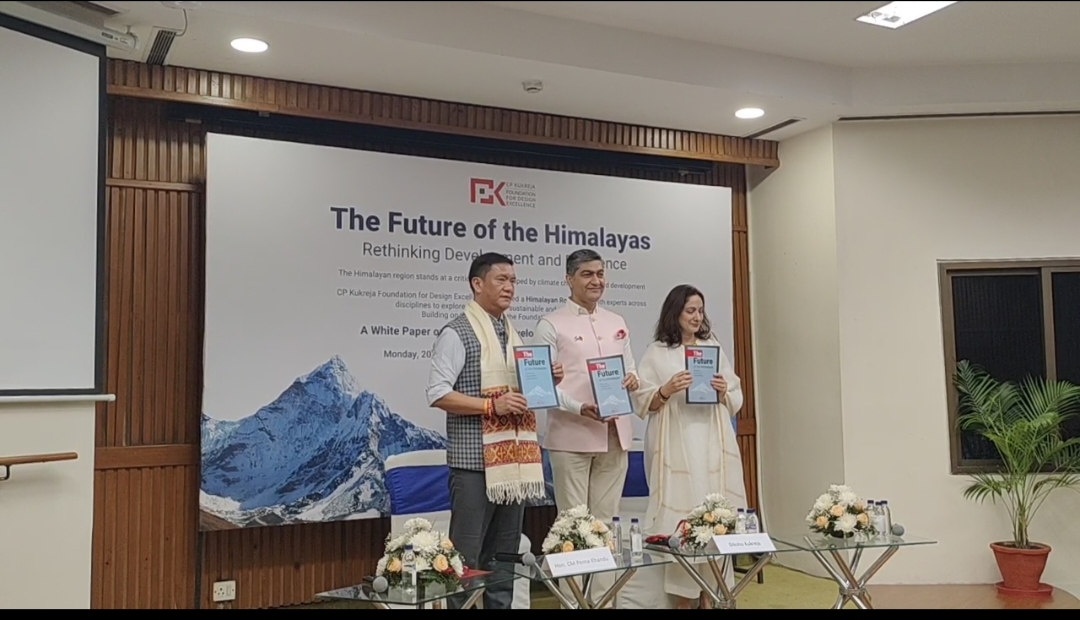
New Delhi: The CP Kukreja Foundation for Design Excellence (CPKF) on Tuesday unveiled a landmark White Paper titled “The Future of the Himalayas: Rethinking Development and Resilience” at the India International Centre, calling for a fundamental shift in how development is planned and executed across the fragile Himalayan region.
The report was launched in the presence of Arunachal Pradesh Chief Minister Pema Khandu, who stressed the need to balance ecological preservation with economic growth in mountain states.
The White Paper is the outcome of a multidisciplinary Himalayan Roundtable convened by the Foundation, bringing together experts from governance, infrastructure, ecology, engineering, and social sciences to examine the increasing complexity of development challenges in the region.
Highlighting the growing climate vulnerability of the Himalayas, the report notes a 15–20 per cent rise in extreme rainfall events since the 1950s, alongside increasing landslide risks and mounting pressure on infrastructure.
It argues that these are not isolated incidents but interconnected outcomes of a deeper mismatch between conventional development models and the realities of fragile mountain ecosystems. It also underscores the importance of recognising ecological carrying capacity as a critical, non-negotiable parameter.
Speaking at the launch, Pema Khandu, Hon’ble Chief Minister of Arunachal Pradesh emphasised the need for a balanced approach to development in mountain states, highlighting that ecological preservation and economic progress must go hand in hand to ensure long-term sustainability.
“The Himalayas are at a critical juncture today, where the need for development must be carefully balanced with ecological sensitivity,” said Khandu. “While local communities seek growth and opportunity, it is essential that we adopt a calibrated, middle-path approach that safeguards this fragile ecosystem.”
Calling the White Paper a “timely step,” he added that “development in the Himalayan region must be approached through an integrated framework, combining scientific assessment, responsible planning, sustainable infrastructure, community participation, and strong policy alignment.”
Introducing the report, Dikshu C. Kukreja emphasised the urgency of moving beyond fragmented planning approaches. “Development in the Himalayas must move beyond project-led interventions to a more systemic and context-sensitive framework,” he said. “Aligning infrastructure with terrain, data, and long-term resilience is no longer optional, it is essential.”
The White Paper recommends transitioning from project-based development to system-level planning, aligning infrastructure with watershed and basin-scale ecological processes, and integrating scientific data into governance frameworks.
It also underscores the need for terrain-responsive infrastructure design and the recognition of ecological carrying capacity as a non-negotiable factor in decision-making.
Reframing the significance of the region, the report highlights that the Himalayas are not isolated geographies but interconnected systems that directly impact nearly 1.3 to 1.5 billion people downstream across South Asia.
It also identifies key structural gaps that continue to challenge sustainable development in the region, including fragmented governance, underutilisation of scientific data, misalignment between engineering practices and terrain realities, and rising pressures from tourism and rapid urbanisation.
A panel discussion titled “Resilient and Sustainable Futures for the Himalayan Region” was also held on the sidelines of the launch, featuring experts who deliberated on the need for coordinated, science-driven and policy-aligned approaches to ensure long-term resilience in the Himalayan ecosystem.