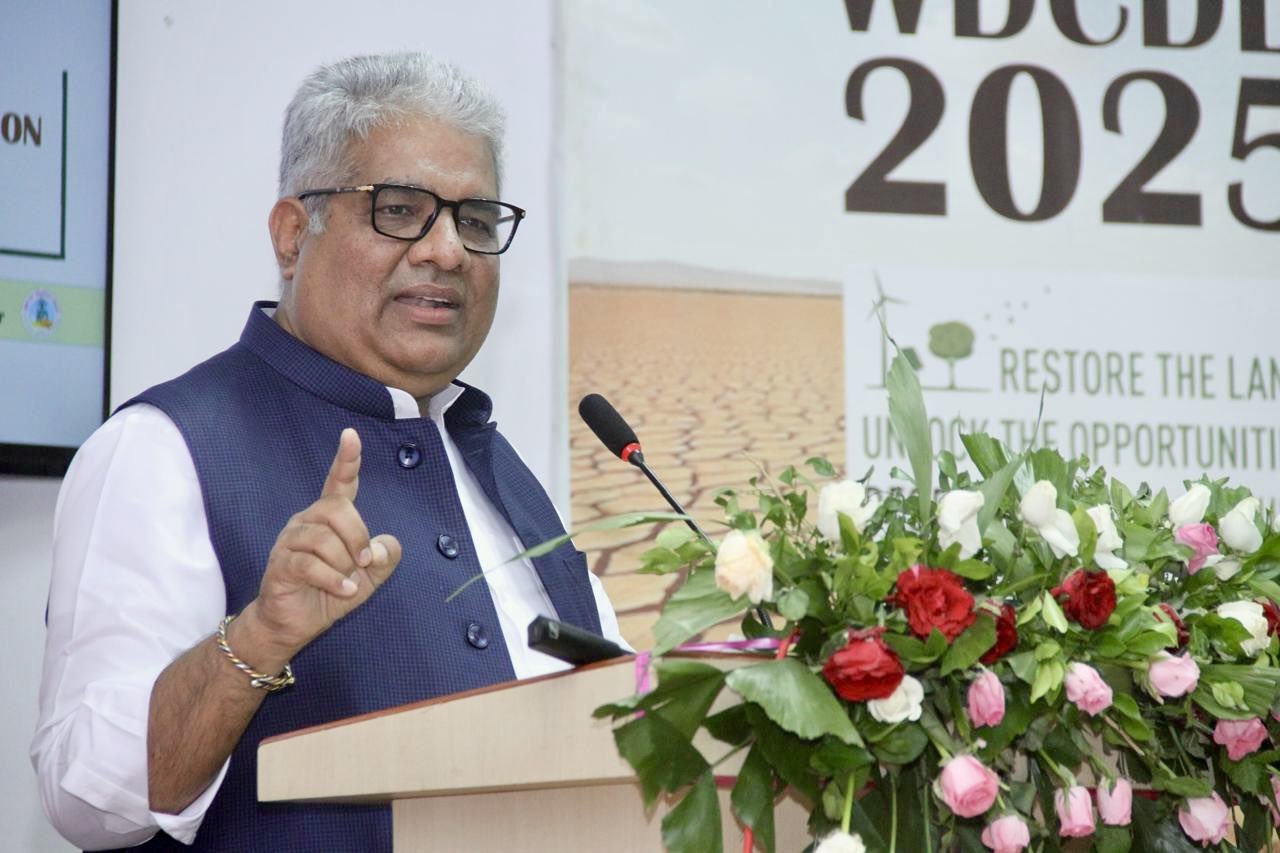
Environment Minister Bhupender Yadav warned that a significant portion of India’s land is facing challenges due to Desertification, caused by the excessive use of fertilisers like urea and indiscriminate pesticides.
The Union Minister raised these concerns while speaking at a day National workshop on “Strategies for Combating Desertification and Drought” at AFRI, Jodhpur, on the occasion of the World Day to Combat Desertification and Drought 2025.
“Unsustainable agricultural practices, not only degrade the land but also pose a threat to food security and biodiversity”, Yadav asserted.
Highlighting India’s proactive measures to combat desertification and promote ecological restoration, he emphasised the importance of sustainable agricultural practices, community-driven initiatives, and the preservation of natural ecosystems.
In line with India’s commitment to the UN Convention to Combat Desertification, the Minister said the government has adopted a comprehensive approach focusing on ecosystem restoration, drought resilience, and biodiversity enhancement.
Addressed an event for national observance of World Day to Combat Desertification and Drought 2025 in Jodhpur today in the presence of Union Minister of Culture and Tourism Shri @gssjodhpur ji.
— Bhupender Yadav (@byadavbjp) June 17, 2025
Desertification, as we know, is not only an ecological problem, but a direct threat… pic.twitter.com/0xu2XMrLXV
Yadav emphasised that healthy land is crucial for regional stability and economic prosperity, urging nations to join efforts in combating land degradation.
He further said that the Aravalli Mountain range, spanning 700 kilometres across 29 districts, holds significant ecological and cultural importance.
The Minister stated that this event reaffirmed India’s leadership role under the UN Convention to Combat Desertification (UNCCD) and demonstrated its progress toward achieving land degradation neutrality by 2030, with a strong focus on knowledge exchange, collaboration, and field-level impact.
Speaking about the Aravallis, Yadav said that the Aravallis are not only a natural barrier against desertification but also a cradle of India’s civilisation and heritage.
He urged local communities to actively participate in conservation efforts and restore degraded areas through collaborative actions.
Looking ahead to 2047, the Minister expressed confidence that India will achieve its green economy goals by integrating ecological sustainability with economic development.
He reiterated that the nation’s development trajectory will be aligned with ecological preservation, ensuring a harmonious balance between growth and environmental stewardship.
During the event, important publications and initiatives were also released on the occasion, including:-
-Information Booklet on Aravalli Districts
-Revised Mission Document of the Green India Mission
-Book on Sustainable Land Management (SLM)
-Launch of the National Afforestation Monitoring System (NAMS)
-Distribution of AFRI Shesham Clones to ten farmers by the Hon’ble Environment Minister.
The event concluded with a wrap-up session affirming India’s commitment to science-based, participatory, and policy-driven desertification mitigation.