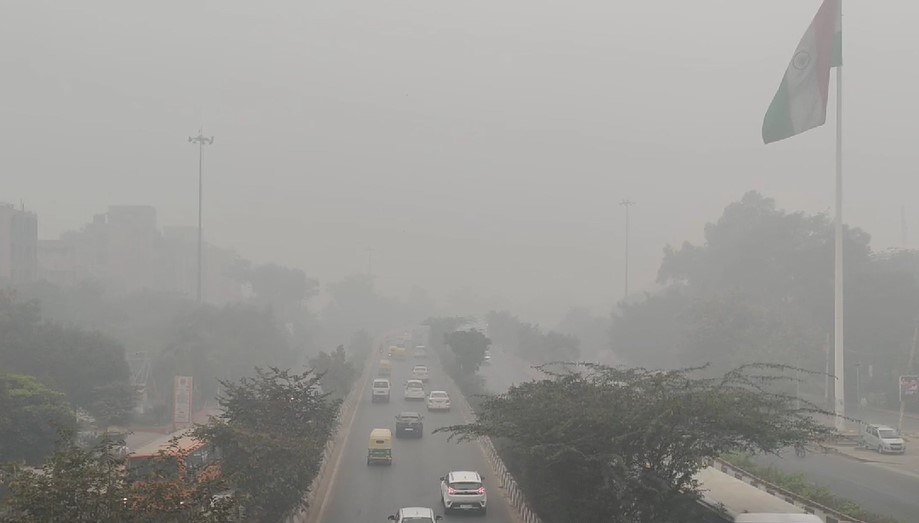
New Delhi: Delhi emerged as the world’s most polluted major city on Saturday morning, as a sharp deterioration in air quality pushed pollution levels to alarming heights just days ahead of Diwali, raising fresh concerns over public health and the effectiveness of the national capital’s pollution-control measures.
According to Swiss air quality monitoring organisation IQAir, Delhi recorded a US Air Quality Index (AQI) of 581 on its live global ranking, placing it at the top among the world’s major polluted cities. The reading was more than twice that of neighbouring Lahore in Pakistan, which recorded a US AQI of 285.
The figures highlighted the severity of the pollution crisis gripping the national capital as winter approaches and atmospheric conditions increasingly favour the accumulation of pollutants close to the ground.
India’s Central Pollution Control Board (CPCB), meanwhile, recorded an AQI of 363, categorising Delhi’s air quality as ‘very poor’. Although the two figures are based on different monitoring systems and AQI scales, both indicated a serious deterioration in air quality and the growing public-health challenge facing Delhi and the wider National Capital Region (NCR).
With Diwali approaching, the deteriorating situation has heightened fears that pollution levels could rise further, particularly if firecracker emissions combine with vehicular pollution, construction dust, industrial emissions and smoke from agricultural residue burning in neighbouring states.
Schools, offices asked to reduce exposure
Amid the worsening air quality, authorities have directed schools in Delhi and surrounding areas to offer online classes, while work-from-home arrangements have also been encouraged to reduce people’s exposure to polluted outdoor air.
The measures reflect growing concern over the impact of toxic air on children, elderly people and those suffering from respiratory and cardiovascular conditions.
Children are particularly vulnerable because their lungs are still developing and they generally breathe more air relative to their body weight than adults.
Prolonged exposure to fine particulate matter can aggravate asthma, trigger respiratory infections and increase the risk of other health complications.
For residents, the pollution emergency has once again disrupted daily life, with outdoor activities, morning walks and school-related routines coming under pressure.
Multiple sources contributing to Delhi’s pollution
Delhi’s air pollution is not the result of a single source. It is a combination of emissions generated within the city and pollution transported from surrounding regions.
Vehicular emissions remain a major contributor, particularly from diesel-powered vehicles, older vehicles and heavy-duty transport. The large number of vehicles operating across Delhi-NCR adds substantial quantities of particulate matter and nitrogen oxides to the atmosphere.
Construction activity and road dust are other important sources. Dust generated from construction sites, uncovered material, poorly maintained roads and movement of vehicles can contribute significantly to particulate pollution, particularly PM10.
Industrial emissions, diesel generator sets, waste burning and household fuel combustion also add to the pollution burden.
The situation becomes more complicated during October and November, when smoke from agricultural residue burning in Punjab, Haryana and parts of Uttar Pradesh can travel towards the national capital under favourable wind conditions.
Although the contribution from stubble burning varies from day to day depending on wind direction, weather conditions and the number of active fires, it can become an additional source of pollution during the post-monsoon period.
Winter weather traps pollutants
Meteorological conditions play a crucial role in determining the severity of Delhi’s air pollution.
As temperatures fall, atmospheric mixing and ventilation can weaken, while low wind speeds allow pollutants to remain concentrated near the surface. Temperature inversion, in which a layer of warmer air sits above cooler air near the ground, can further restrict the vertical dispersion of pollutants.
The reduction in the atmospheric boundary layer during winter also means that emissions become concentrated in a relatively smaller volume of air.
Consequently, even when emissions remain relatively unchanged, pollution levels can rise sharply because the atmosphere is unable to disperse them effectively.
This combination of high emissions and unfavourable weather conditions makes the October-January period particularly challenging for Delhi-NCR.
Diwali raises fears of another pollution spike
The approaching Diwali festival has added another dimension to the pollution emergency.
Firecrackers release particulate matter and a range of gaseous pollutants, including sulphur dioxide and nitrogen oxides. They can also introduce metals and other chemical compounds into the atmosphere, depending on their composition.
The impact can be particularly severe when firecracker emissions coincide with stagnant weather conditions and an already high background concentration of pollutants.
Experts have repeatedly warned that the cumulative impact of firecrackers, traffic emissions, dust and regional pollution can push air quality to even more dangerous levels during the festive period.
The concern is not limited to the night of Diwali. Pollutants released during celebrations can remain suspended in the atmosphere, particularly when wind speeds are low and dispersion conditions are unfavourable.
Public health concerns mount
The deterioration in air quality has serious implications for public health.
Fine particulate matter, particularly PM2.5, is considered one of the most dangerous components of air pollution because its microscopic size allows it to penetrate deep into the lungs and enter the bloodstream.
Exposure can aggravate asthma and chronic obstructive pulmonary disease (COPD), worsen existing heart and lung conditions and increase the risk of cardiovascular complications.
Even healthy individuals may experience coughing, throat irritation, breathlessness and eye irritation during periods of severe pollution.
Children, senior citizens, pregnant women and people with pre-existing respiratory or cardiac conditions face particularly high risks.
Health experts generally advise people to avoid strenuous outdoor exercise during severe pollution episodes, keep windows closed when outdoor air quality is particularly poor and seek medical advice if they experience persistent breathing difficulties or other concerning symptoms.
Pollution-control measures face a major test
The latest deterioration has once again placed Delhi’s pollution-control strategy under scrutiny.
Authorities have relied on a combination of restrictions on polluting vehicles, dust-control measures, industrial inspections, mechanised road sweeping, water sprinkling and restrictions on construction activities to tackle the crisis.
The Graded Response Action Plan (GRAP) provides a framework for introducing progressively stricter measures as air quality deteriorates.
However, the recurring winter pollution crisis raises questions about whether emergency restrictions alone can address a problem that has deep-rooted regional and structural causes.
Delhi’s pollution cannot be tackled through isolated action within the city’s administrative boundaries. It requires coordinated measures involving Delhi, Haryana, Punjab, Uttar Pradesh and other parts of the NCR, particularly on transport emissions, industrial pollution, construction dust and agricultural residue management.
The challenge is also one of sustained enforcement. Restrictions announced during pollution emergencies need to be backed by effective monitoring, accountability and long-term reductions in emissions.
With Diwali approaching and winter conditions setting in, Delhi faces another critical test in its battle against toxic air. The latest readings are a stark reminder that clean air cannot be secured through seasonal restrictions alone but requires year-round action and cooperation across state boundaries.