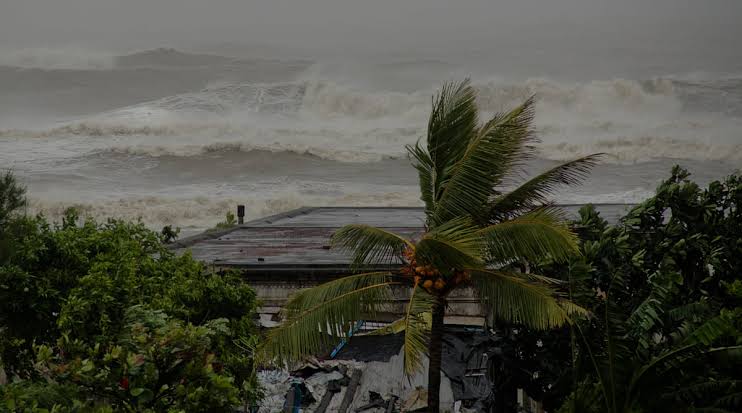
New Delhi: Very Severe Cyclonic Storm Arnab has begun making landfall along the Andhra Pradesh coast between Bapatla and Visakhapatnam, close to south of Yanam, bringing destructive winds, torrential rainfall and widespread disruption across coastal areas.
According to the India Meteorological Department (IMD), the landfall process commenced at approximately 1:20 am on Wednesday, October 28. The cyclone was packing maximum sustained wind speeds of 125–135 kmph, with gusts reaching up to 150 kmph.
The IMD said the northern spiral band of the cyclone had already moved over land, while the centre remained extremely close to the coastline.
In its latest update at 5:30 am, the IMD said the cyclone was practically stationary along the Andhra Pradesh coast and that the landfall process was expected to continue for another two to three hours.
IMD Director General Mrutyunjay Mohapatra said the winds would continue at 125–135 kmph, with gusts up to 150 kmph, during the crossing. The complete landfall process was expected to take around four hours. India News +2
Coastal Andhra bears the brunt
The impact of the cyclone has been reported across several coastal districts, including Kakinada, Konaseema, West Godavari, Anakapalli and Visakhapatnam.
Strong winds and torrential rainfall have uprooted trees, snapped electricity lines, submerged roads and disrupted power supplies in several locations. Police and emergency personnel have also rescued residents stranded by floodwaters.
According to reports available on Wednesday morning, gusty winds of 125–135 kmph were affecting Kakinada, Konaseema and West Godavari districts.
Andhra Pradesh Chief Minister N. Chandrababu Naidu reviewed the situation on Wednesday morning and directed officials to remain alert and coordinate rescue and relief operations. India News +3
Nearly 1.37 lakh people evacuated
Large-scale evacuation and emergency preparedness operations were undertaken in Andhra Pradesh and neighbouring Odisha ahead of the cyclone.
According to the Associated Press, at least 89,000 people were evacuated from vulnerable and flood-prone areas in Andhra Pradesh. Odisha authorities also planned to evacuate approximately 48,000 people.
Together, these figures represent around 1.37 lakh people moved or scheduled to be moved to safer locations.
Andhra Pradesh had established more than 2,000 cyclone shelters across 20 districts, deployed medical teams and arranged ambulances and emergency facilities. In Odisha, rescue teams and temporary shelters were also placed on alert.
The authorities have prioritised the protection of people living in low-lying coastal areas, particularly those exposed to storm surges and flooding. AP News +2
Heavy rainfall threat extends beyond Andhra Pradesh
The danger from Arnab is not limited to the coastline. The weather system is expected to move inland and bring widespread rainfall across several eastern and central Indian states.
The IMD has warned of heavy to extremely heavy rainfall in different regions over the coming days. Andhra Pradesh and Yanam: Heavy to extremely heavy rainfall, particularly in coastal districts.
The rainfall associated with the system could increase the risk of flash floods, waterlogging, landslides, damage to infrastructure and disruption of road and rail transportation.
Storm surge and transport disruptions
The IMD had also warned of a storm surge of approximately 1.5–2.5 metres above the astronomical tide in low-lying coastal areas of Andhra Pradesh during the cyclone’s passage. Such a surge can inundate coastal settlements and worsen flooding, particularly when combined with heavy rainfall and high tides. India News
Railway services in the affected region have been disrupted, with at least 50 trains cancelled as a precautionary measure. Flight operations and road transportation have also faced disruptions.
Fishermen have been advised not to venture into the sea along the Andhra Pradesh, Odisha and Yanam coasts.
A wider disaster management challenge
The slow movement of the cyclone near the coast and its prolonged landfall process have increased concerns about the duration of destructive winds and heavy rainfall.
The immediate challenge for disaster management agencies will be to prevent casualties, restore essential services, evacuate people from vulnerable locations and ensure that relief supplies reach affected communities.
Residents in coastal and flood-prone districts have been advised to remain indoors, avoid flooded roads, stay away from fallen electrical wires and follow instructions issued by local administrations.