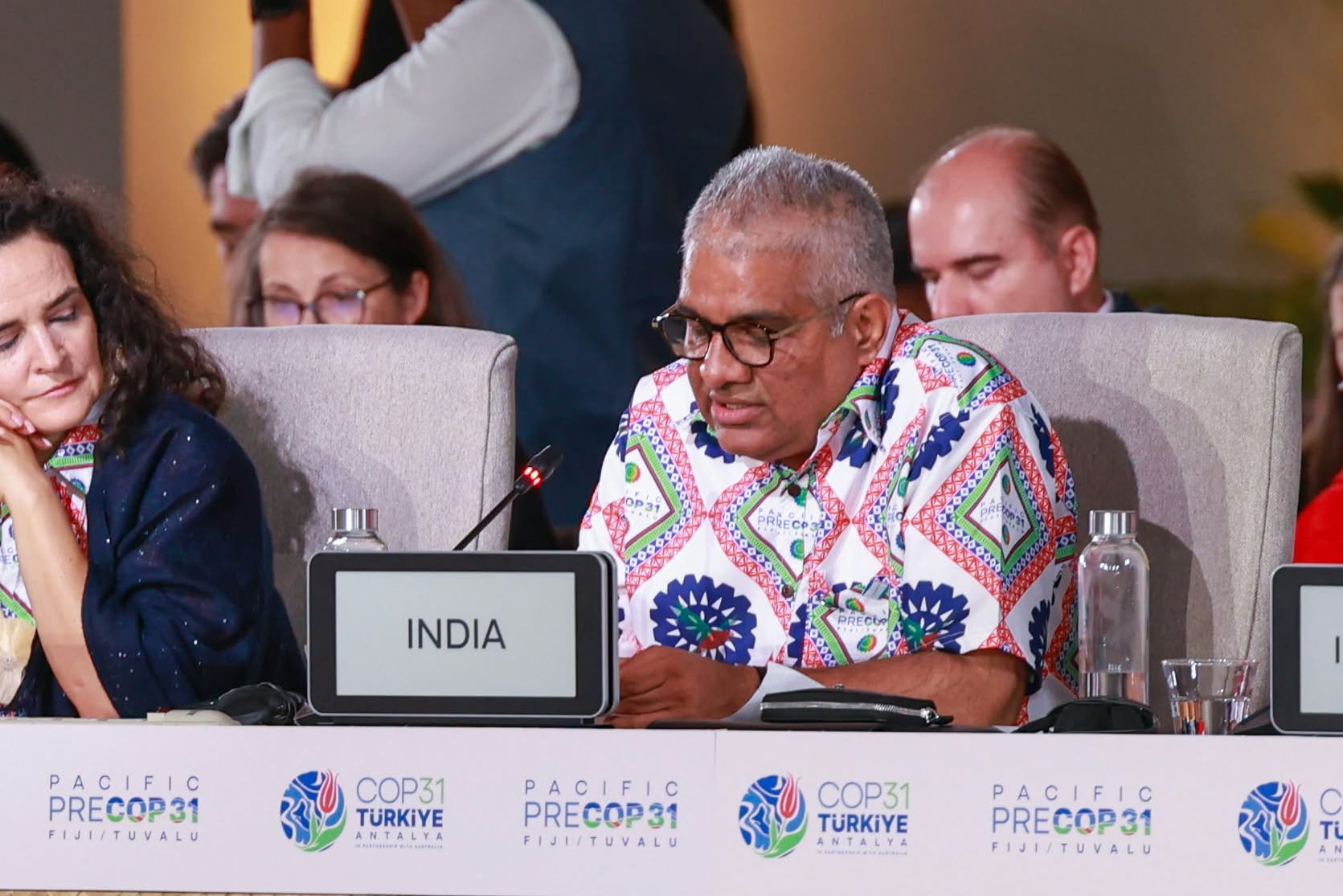
Fiji: India has called for greater focus on closing gaps in understanding, fulfilling existing climate commitments and accelerating implementation of the Paris Agreement at the UNFCCC Pre-COP31 meeting in Fiji.
Addressing the plenary discussion on COP31 priorities, Union Minister for Environment, Forest and Climate Change Bhupender Yadav, who is leading the Indian delegation, said the long-term objectives of climate action have already been established under the UN Framework Convention on Climate Change (UNFCCC) and the Paris Agreement, including the goal of limiting global temperature rise to 1.5°C.
The Pre-COP31 meeting is being co-hosted by Australia, Fiji and Tuvalu.
Yadav began his intervention by acknowledging the people of Tuvalu for what he described as their efforts to confront the challenges posed by climate change. He said Tuvalu’s experience demonstrated resilience and offered an example of how communities can respond to climate-related challenges.
The minister said that achieving the 1.5°C ambition would require adequate means of implementation, including resources, capacity and technology. He said the immediate focus should be on assessing how countries can accelerate progress towards the goals already agreed under the climate framework.
Referring to the COP31 Presidencies’ emphasis on consensus, decision-making and implementation, Yadav said there is broad agreement on the long-term direction of international climate action. However, he highlighted the need to build greater consensus around existing gaps in understanding.
These gaps, he said, include those between scientific knowledge and traditional knowledge and community practices, between practices and ethics, and between available resources and the needs experienced on the ground.
India called on COP31 to make efforts to address these gaps and strengthen a common understanding of the challenges and solutions.
On decision-making, Yadav said the key task before Parties is to fulfil their existing commitments under the UNFCCC and the Paris Agreement “in true letter and spirit” while enabling each country to meet its responsibilities.
On implementation, he stressed the importance of directing efforts towards areas where needs are greatest and where the impacts of climate change are most visible and widely felt.
He also called for stronger capacity building and urged countries to bring concrete examples and success stories to the UN climate process each year, particularly in the areas of high-impact mitigation, large-scale adaptation and effective delivery of climate finance and other means of implementation.
Yadav said that consistently sharing and scaling successful initiatives could help deliver stronger results on the ground and contribute to achieving the objectives of the Paris Agreement.
He said the outcome of COP31 in Antalya, Türkiye, should not be measured simply by the adoption of new targets or declarations. Instead, he said, success should be assessed by whether implementation has accelerated, whether support has reached communities and countries that need it most, and whether existing climate solutions can be scaled up.
India’s message at the Pre-COP31 meeting therefore centred on moving from commitments to delivery, with greater emphasis on implementation, capacity building, support and scaling proven climate solutions.