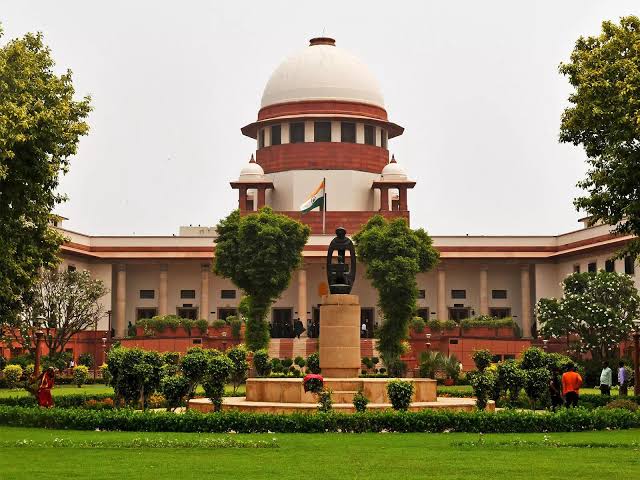
New Delhi: In a suo motu case initiated over concerns surrounding revised definition of Aravalli Hills, the Supreme Court on Monday has kept in abeyance its earlier directions concerning the change in definition of Aravalli Hills, after expressing concern that the expert committee report and the Court’s observations were being misconstrued.
A bench of Chief Justice of India Surya Kant, Justice JK Maheshwari and Justice AG Masih said further clarification was required before the report or the Court’s directions could be implemented, and issued notice on the suo motu case to be heard on 21st January.
“We deem it necessary that Committee recommendation and directions of this Court be kept in abeyance. Stay to remain in effect till constitution of the Committee”, the Court stated.
It may be recalled that the suo motu case was initiated following concerns that the recent change in the definition of Aravalli Hills could open doors to unregulated mining and environmental damage.
The Court said that prior to implementation, a fair, impartial and independent expert opinion must be considered to provide definitive guidance.
It noted the need to examine whether the definition of the Aravalli Hills and Ranges had created a structural paradox, and whether it had inversely broadened the scope of non-Aravalli areas, thereby facilitating the continuation of unregulated mining.
The Bench also flagged specific concerns requiring examination, including whether regulated mining would be permitted in the 500-metre gaps between hills, and if so, what precise structural parameters would be used to ensure that ecological continuity was not compromised.
The Court said it must be determined whether the concern that only 1,048 hills out of 12,081 meet the 100-metre elevation threshold was factually and scientifically correct, and whether a geological enquiry was necessary.
Chief Justice Surya Kant said the Court proposed to constitute a high-powered expert committee to holistically assess the report and examine these questions.
The proposed exercise would also include a detailed identification of territories that would be excluded from the Aravalli area, and an assessment of whether such exclusion could risk degradation and compromise the ecological integrity of the Aravalli range.
The case, titled “IN RE: DEFINITION OF ARAVALLI HILLS AND RANGES AND ANCILLARY ISSUES”, was heard by a bench comprising Chief Justice of India Surya Kant and justices JK Maheshwari and AG Masih, in a special sitting.
The development assumes significance as the earlier ruling that accepted the contested definition of the Aravallis was also delivered by a three-judge bench led by former Chief Justice of India Bhushan R Gavai.
On November 20, the top court had accepted a uniform definition of the Aravalli hills and ranges and banned grant of fresh mining leases inside its areas spanning Delhi, Haryana, Rajasthan and Gujarat until experts’ reports are out.
The apex court had accepted the recommendations of a committee of Ministry of Environment, Forest and Climate Change (MoEF&CC) on the definition of Aravalli hills and ranges to protect the world’s oldest mountain system.
The committee recommended that “Aravalli Hill” will be defined as any landform in designated Aravalli districts with an elevation of 100 metres or more above its local relief and an “Aravalli Range” will be a collection of two or more such hills within 500 metres of each other, PTI reported.
The Aravalli Hills and Ranges are among India’s oldest geological formations, spanning between Delhi to Gujarat through Haryana and Rajasthan.
Historically, they have been recognised across 37 districts by state governments, with their ecological role noted as a natural barrier against northern desertification and a protector of biodiversity and water recharge.
The committee, while defining Aravalli hills, said, “Any landform located in the Aravalli districts, having an elevation of 100 metres or more from the local relief, shall be termed as Aravalli Hills.
The entire landform lying within the area enclosed by such lowest contour, whether actual or extended notionally, together with the Hill, its supporting slopes and associated landforms irrespective of their gradient, shall be deemed to constitute part of the Aravalli Hills.”
The panel also defined Aravalli Range and said, “Two or more Aravalli Hills …, located within the proximity of 500m from each other, measured from the outermost point on the boundary of the lowest contour line on either side forms Aravalli Range.
The Supreme Court earlier emphasised that uncontrolled mining here poses a “great threat to the ecology of the nation” and directed uniform criteria to safeguard them. Their conservation is thus vital for ecological stability, cultural heritage, and sustainable development.