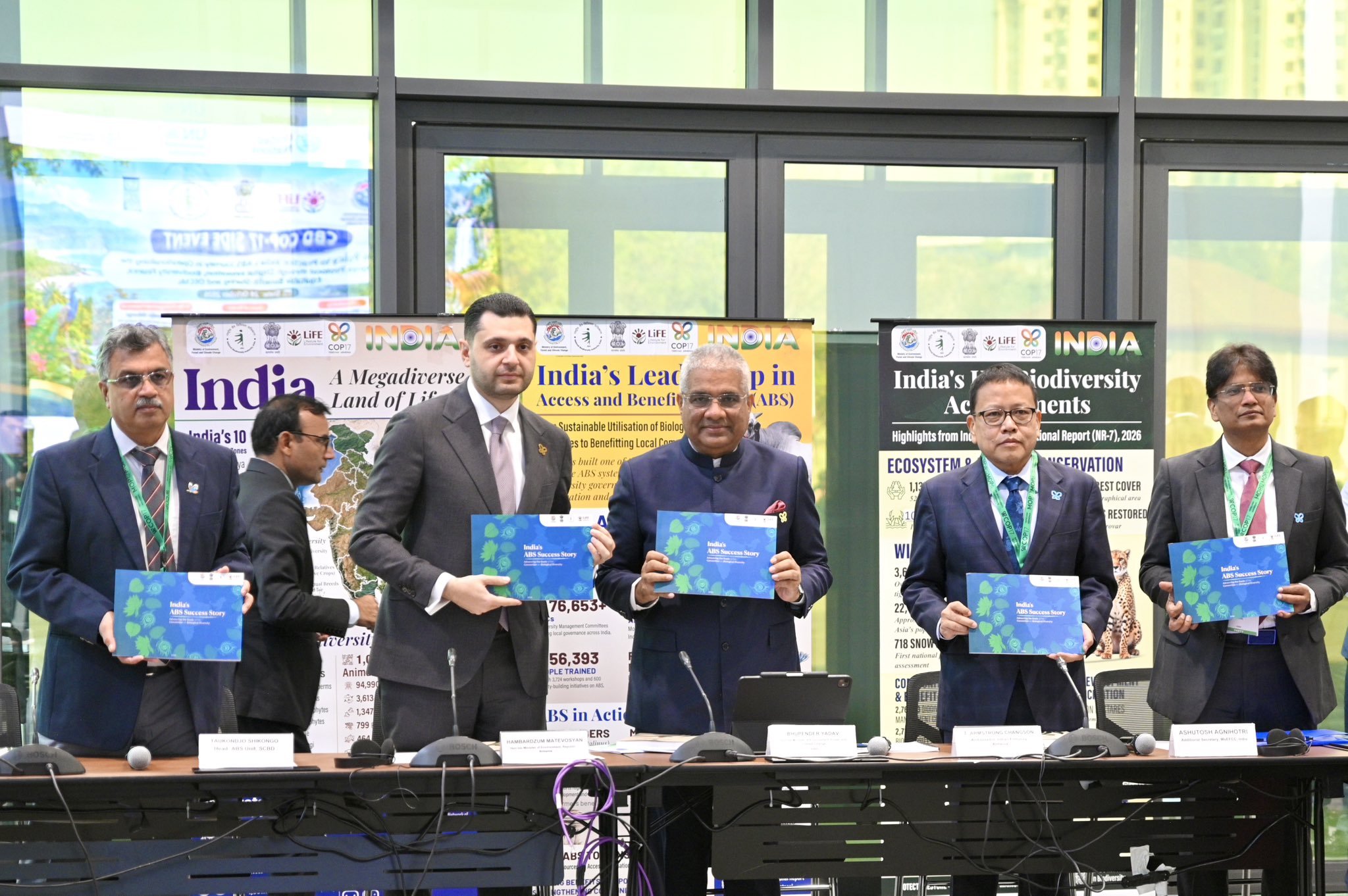
Yerevan, Armenia: Union Minister for Environment, Forest and Climate Change Bhupender Yadav has called for translating global biodiversity commitments into effective implementation, sustainable financing and measurable conservation outcomes.
He emphasised that achieving international biodiversity targets requires stronger institutional capacities, adequate financial resources, technological innovation and active participation of local communities.
Addressing a side event of the 17th Conference of the Parties (COP17) to the Convention on Biological Diversity (CBD) in Yerevan, Armenia, the Minister said that adopting ambitious global conservation targets alone would not be sufficient unless countries developed the necessary mechanisms and resources to implement them effectively.
The event, titled “From Policy to Practice: Advancing India’s Biodiversity Commitments through Innovation, Finance, ABS and OECMs,” was organised by the Ministry of Environment, Forest and Climate Change in partnership with India’s National Biodiversity Authority (NBA) and the United Nations Development Programme (UNDP).
The event was attended by COP17 President and Armenia’s Environment Minister Hambardzum Matevosyan and Head of the Access and Benefit-sharing (ABS) Unit at the CBD Secretariat, Dr. Taukondjo Shikongo.
In his keynote address, Mr. Yadav highlighted the importance of strengthening implementation capacities and ensuring sustained financial support for biodiversity conservation.
Referring to the Kunming-Montreal Global Biodiversity Framework, he said countries must move beyond setting conservation targets and focus on developing institutional mechanisms, mobilising resources and delivering tangible results.
The Minister stressed that biodiversity conservation and sustainable use of natural resources must contribute to human well-being while ensuring intergenerational equity.
Highlighting India’s approach, he said biodiversity is deeply connected with people’s lives, traditional knowledge, cultural practices and livelihoods. He emphasised that environmental protection and economic development should complement rather than compete with each other.
Mr. Yadav also underlined the significance of India’s Lifestyle for Environment (LiFE) initiative, which promotes environmentally responsible behaviour, sustainable consumption and individual participation in protecting natural resources.
He said sustainable lifestyle choices and responsible consumption patterns are essential for maintaining ecological balance and strengthening the relationship between people and nature.
India releases four key biodiversity publications:-
A major highlight of the event was the release of four publications aimed at strengthening India’s biodiversity governance, conservation planning, biosafety reporting and benefit-sharing mechanisms.
-The Guidelines for the Designation of India’s Other Effective Area-Based Conservation Measures (I-OECMs) 2026 provide a framework for recognising conservation achievements outside conventional protected areas.
-The guidelines acknowledge that effective biodiversity conservation can take place across different landscapes and management systems, provided they meet appropriate conservation criteria and governance requirements.
-The Fifth National Report on the Cartagena Protocol on Biosafety reflects India’s commitment to transparent reporting, responsible biosafety governance and international cooperation in addressing biosafety concerns.
-The Convention on Biological Diversity Handbook: Reference Guide and Indian Perspective aims to provide accessible information on the Convention and its implementation processes. It is expected to support informed participation and strengthen institutional continuity in international biodiversity negotiations.
The fourth publication, India’s ABS Success Story, highlights the country’s achievements and experience in implementing Access and Benefit-sharing mechanisms and its internationally recognised leadership in this area.
Emphasising the importance of Access and Benefit-sharing, Mr. Yadav said the Nagoya Protocol provides an international framework for ensuring fair and equitable sharing of benefits arising from the utilisation of genetic resources.
He stressed that these principles must be supported by practical, transparent and equitable procedures that benefit communities and other stakeholders involved in biodiversity conservation.
The Minister highlighted India’s experience in combining policy reforms with institutional capacity-building, digital innovation and cooperation among local communities and responsible businesses.
He said effective benefit-sharing mechanisms can help ensure that the economic and other benefits derived from biological resources are distributed fairly, while encouraging their conservation and sustainable use.
India’s approach also recognises the importance of traditional knowledge and the contribution of communities that have preserved and sustainably managed biological resources over generations.
International cooperation essential for biodiversity goals:-
Calling for stronger international partnerships, Mr. Yadav said no country could achieve the objectives of the Global Biodiversity Framework in isolation.
He emphasised the importance of cooperation that respects national priorities, facilitates the exchange of practical knowledge and improves access to appropriate financial resources and technologies.
The Minister welcomed greater collaboration among countries in developing effective conservation strategies and adapting successful approaches to local ecological, social and economic conditions.
He also reaffirmed India’s commitment to South-South cooperation and knowledge-sharing, particularly among developing countries facing common challenges related to biodiversity loss, resource mobilisation and conservation capacity.
Mr. Yadav stressed that international partnerships must focus on practical implementation and enable countries to convert global commitments into meaningful conservation achievements.
Reaffirming India’s commitment to the Kunming-Montreal Global Biodiversity Framework, the Minister said the country would continue working constructively with other Parties and international partners to advance biodiversity conservation and sustainable resource management.
He highlighted the need for an integrated approach combining innovation, sustainable financing, strong institutions, community engagement and international cooperation.
The discussions at the COP17 side event underscored India’s emphasis on moving from biodiversity policy commitments to practical implementation, with a focus on ecological sustainability, equitable benefit-sharing and long-term conservation outcomes.