New Delhi: In a significant step towards harmonising infrastructure development with ecological conservation, the Standing Committee of the National Board for Wildlife (SC-NBWL) on Monday considered 70 proposals linked to public utilities, defence and infrastructure projects in and around India’s protected wildlife areas.
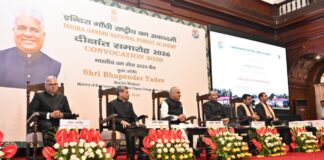
The decision was taken during the 88th meeting of the Committee was chaired by Union Minister for Environment, Forest and Climate Change, Bhupender Yadav here on Monday.
The proposals pertain to projects located in Protected Areas, Wildlife Sanctuaries, Tiger Reserves and Eco-Sensitive Zones, and were examined in accordance with the provisions of the Wild Life (Protection) Act, 1972.
The Committee emphasised a balanced approach, ensuring ecological sensitivity and statutory compliance while addressing essential developmental and strategic needs.
Among the key public utility projects deliberated were drinking water supply schemes under the Jal Jeevan Mission (JJM), establishment of primary and community health centres, widening of roads, installation of 4G mobile towers and laying of transmission lines to improve connectivity and basic services for local communities.
The Committee also reviewed proposals for a medium irrigation project in Madhya Pradesh, aimed at providing drinking and irrigation water in the drought-prone Bundelkhand region.
The project is expected to not only support human needs but also improve water availability for wildlife, including gharials, thereby strengthening the regional ecosystem.
In addition, 17 defence-related proposals, mainly located in the Union Territory of Ladakh and the State of Sikkim were considered. These projects involve strategic infrastructure in border and high-altitude areas and were recommended keeping in view national security imperatives, with strict conditions on wildlife mitigation measures and environmental safeguards.
The meeting also took stock of the Action Taken Report (ATR) on decisions and directions issued in earlier meetings, particularly those related to policy reforms and process streamlining, including improvements to the PARIVESH portal.
The Committee decided that wildlife conservation policies and compliance with SC-NBWL directions would be further reviewed in future meetings to strengthen monitoring and implementation.
The Standing Committee of the National Board for Wildlife, a statutory body under the Wild Life (Protection) Act, 1972, plays a crucial role in advising the Government on wildlife conservation while ensuring that development activities near protected areas proceed in a sustainable and responsible manner.