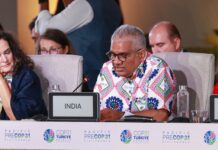
Belem, Brazil: Environment Minister Bhupender Yadav has announced that India will publish its revised Nationally Determined Contribution (NDC) for the 2035 period by December this year.
Speaking at the high-level segment of the UN COP30 Climate Summit in Belem, he emphasized that climate change is “real and imminent,” driven by decades of unsustainable growth and development patterns.
He urged developed countries to advance their net-zero timelines, saying their current commitments fall short of what is needed to confront the escalating climate crisis.
Mr. Yadav underscored that climate action must be supported with finance and technology that is “adequate, accessible, affordable, and free from restrictive intellectual property barriers.”
The Minister highlighted India’s newly launched Nuclear Mission and Green Hydrogen Mission as key initiatives that will accelerate the country’s path toward achieving net zero by 2070.
India will also release its first Biennial Transparency Report soon, reflecting its enhanced climate reporting obligations under the Paris Agreement.
Under the Paris Agreement, NDCs are national climate plans that outline targets to reduce emissions and adapt to climate impacts. Countries must submit their third round of NDCs, known as “NDCs 3.0”, covering the 2031–2035 period this year.
Mr. Yadav noted that COP30 marks a decade since the signing of the Paris Agreement, calling it a critical milestone to assess global ambition and collective progress.
India’s forthcoming NDC update is expected to play a significant role in shaping global climate ambition as countries enter the next phase of climate planning for 2035 and beyond.
Reiterating India’s call for fairness and responsibility in climate negotiations, the Minister said COP30 should be remembered as a “COP of Implementation” and a “COP of delivery on promises.”
He pressed developed countries to demonstrate greater climate ambition and honour their pledges, including climate finance and technology support for developing nations.
Highlighting India’s progress so far, Mr. Yadav said the country’s emission intensity has fallen by more than 36 percent since 2005. He added that non-fossil fuel sources now account for over half of India’s total installed electric power capacity, an NDC target achieved five years ahead of the 2030 deadline.
India has also planted more than two billion saplings in just sixteen months under a community-led initiative aimed at enhancing carbon sinks.
On the sidelines of the summit, the Minister addressed the Leadership Group for Industry Transition (LeadIT) Industry Leaders’ Roundtable, where he called for deeper international cooperation to accelerate industrial decarbonization.
Strong global partnerships, he said, will be vital for meeting the goals of the Paris Agreement and securing a sustainable future for the next generations.