

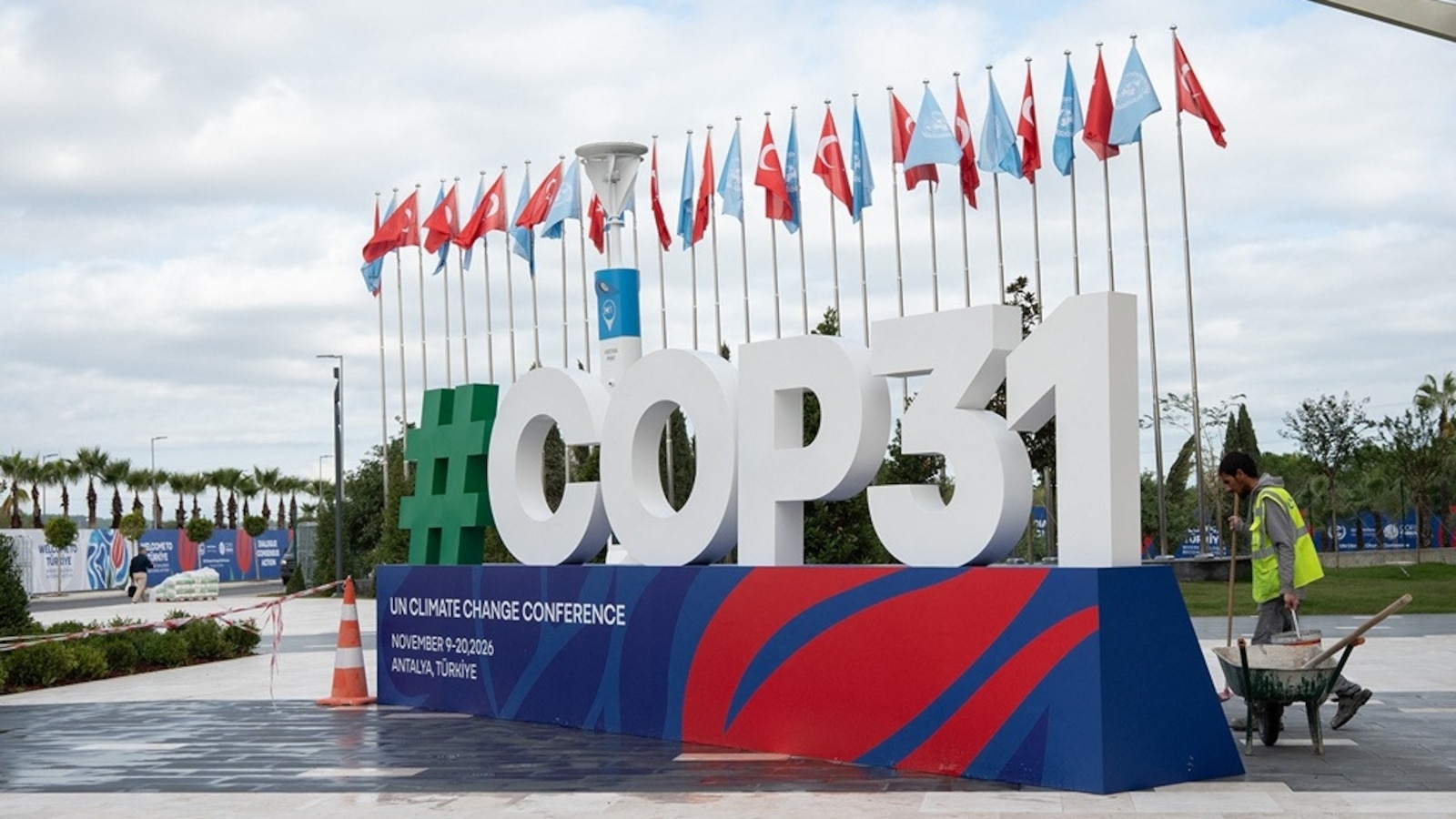
Antalya, Turkiye: The 31st Conference of the Parties to the United Nations Framework Convention on Climate Change (COP31) opens in Türkiye on November 9, 2026, against a backdrop of escalating climate impacts, growing demands for climate finance, disagreements over fossil fuels and concerns about whether countries are doing enough to meet the goals of the Paris Agreement.
The conference, scheduled to run until November 20, comes at a critical moment for international climate diplomacy. Governments are under increasing pressure to turn their climate commitments into measurable action, accelerate the transition towards clean energy, strengthen adaptation to extreme weather and ensure that developing countries receive the financial and technological support needed to address climate change.
For developing nations, particularly India and other countries of the Global South, the central question is not simply how quickly the world can reduce emissions, but also who will pay for the transition, how the costs will be shared and whether climate justice will be reflected in the final decisions. COP31 is therefore expected to be shaped by a combination of environmental urgency, economic considerations, energy security and geopolitical negotiations.
Climate finance: The biggest battle between developed and developing nations:
Climate finance is expected to remain one of the most contentious issues at COP31. Developing countries argue that they are bearing a disproportionate share of climate-related losses despite having contributed relatively little to historical greenhouse gas emissions. They want developed nations to provide predictable, adequate and accessible financial assistance for reducing emissions, adapting to climate change and dealing with climate-induced disasters.
The New Collective Quantified Goal on Climate Finance, agreed at COP29 in Baku, set a target of at least $300 billion annually by 2035 for developing countries, with developed countries taking the lead. It also called for scaling up finance from all sources to at least $1.3 trillion annually by 2035.
The challenge at COP31 will be to translate these financial ambitions into accessible funding, with clear accountability and delivery mechanisms. Why it matters: Without adequate financial support, many developing countries will struggle to implement their climate plans, even when they have the political will to do so.
Fossil fuels and the transition to clean energy:
Several countries want a clearer timetable for reducing dependence on fossil fuels, while others argue that energy security, affordability, national circumstances and development requirements must be considered.
The issue has become even more complicated because of geopolitical conflicts and disruptions to global energy supplies.
The ongoing Iran war and the disruption of oil shipments through the Strait of Hormuz have highlighted the vulnerability of countries heavily dependent on imported fossil fuels.Türkiye is seeking to put electrification at the centre of the summit’s agenda. Its proposed global electrification push aims to increase electricity’s share of global final energy demand to 35% by 2035.
Adaptation: Protecting people from unavoidable climate impacts:
Climate adaptation is moving increasingly towards the centre of international climate negotiations. Even if global emissions decline rapidly, the impacts of climate change will continue because of greenhouse gases already accumulated in the atmosphere.
The world is experiencing increasingly damaging combinations of heatwaves, floods, droughts, wildfires, coastal erosion and changing rainfall patterns.
Developing countries, particularly those in South Asia, Africa and small island states, are especially vulnerable. An important negotiation is the development of measurable indicators under the Global Goal on Adaptation. Countries need a way to assess whether adaptation policies are actually reducing vulnerability, rather than simply counting projects and financial announcements.
National climate commitments and the 1.5°C target:
The Paris Agreement’s temperature goal remains the fundamental reference point for COP31. Countries agreed to hold the increase in global average temperature to well below 2°C above pre-industrial levels while pursuing efforts to limit it to 1.5°C. However, current emissions trajectories remain inconsistent with the required pace of reductions.The United Nations has warned that the world is on track to exceed the 1.5°C warming threshold, at least temporarily.
The challenge at COP31 will be to strengthen the implementation of Nationally Determined Contributions (NDCs), the climate action plans submitted by individual countries. The summit will also launch the second Global Stocktake process, which will assess collective progress towards the Paris Agreement’s objectives.
The key concern is that international climate commitments have expanded, but implementation remains inadequate.
Loss and damage: Compensation for climate-related destruction
Loss and damage has emerged as a critical issue for countries suffering severe climate impacts that cannot be prevented through mitigation or adaptation alone.
For example, when a cyclone destroys homes, rising sea levels permanently inundate coastal settlements or prolonged drought destroys agricultural livelihoods, affected communities may face losses that cannot simply be reversed.
The establishment of the Fund for Responding to Loss and Damage at COP28 was an important development.
However, the availability of adequate funding, its accessibility and the speed of disbursement remain major concerns.
The challenge is to ensure that the fund becomes an effective instrument for climate-vulnerable countries rather than remaining primarily a political commitment.
Technology transfer and the clean-energy divide.
The global clean-energy transition depends not only on money but also on access to technology. Solar panels, battery storage, green hydrogen, smart electricity grids, carbon management technologies and climate-resilient agricultural systems are becoming increasingly important. However, developing countries often face high financing costs, inadequate infrastructure and limited access to advanced technologies.
COP31 is expected to place emphasis on:
-Affordable access to renewable-energy technology.
-Battery storage and grid modernisation.
-Green hydrogen development.
-Technology cooperation between developed and developing economies.
-Climate research and innovation.
-Capacity building and technical assistance.
The issue is particularly important for countries seeking to develop domestic clean-energy manufacturing industries.
The Global South wants to avoid a situation in which the clean-energy transition creates a new technological and economic divide between wealthy and developing nations.
The issue is particularly important for countries seeking to develop domestic clean-energy manufacturing industries.
The Global South wants to avoid a situation in which the clean-energy transition creates a new technological and economic divide between wealthy and developing nations.


[…] href="The”>https://www.theenvironment.in/2026/11/09/cop31-in-turkiye-major-issues-set-to-dominate… Environment — COP31 in Türkiye: Major issues set to dominate the global climate […]