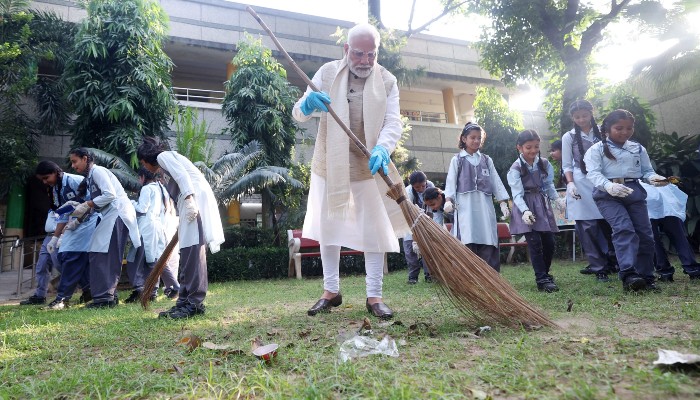
New Delhi: The Union Budget 2026–27 has reduced the allocation for Prime Minister Narendra Modi’s flagship Swachh Bharat Mission by 26 per cent, raising concerns over the government’s commitment to urban sanitation goals. The total outlay for the scheme has been cut to ₹9,692 crore, down from ₹12,192 crore in the previous Budget.
While the allocation for Swachh Bharat Mission–Grameen remains unchanged at ₹7,192 crore, the urban component of the scheme has borne the brunt of the reduction. Funding for Swachh Bharat Mission–Urban has been slashed by half, from ₹5,000 crore in 2025 to just ₹2,500 crore in the current Budget.
This marks the first reduction in funding for the urban component since the 2020 Budget. In contrast, allocations for the rural sanitation programme have remained static since 2022, indicating a prolonged funding plateau.
The Swachh Bharat Mission (Grameen) is implemented by the Department of Jal Shakti, while the urban programme is administered by the Ministry of Housing and Urban Affairs.
Launched on October 2, 2014, Swachh Bharat Mission 1.0 aimed to eliminate open defecation across the country. The government declared the target achieved by October 2, 2019, coinciding with the 150th birth anniversary of Mahatma Gandhi, when all villages were reported as Open Defecation Free.
The second phase of SBM–Grameen, launched in 2019, shifted focus towards solid and liquid waste management and visual cleanliness, with the objective of transforming villages from ODF to ODF Plus by 2024–25. According to a government release issued in January, over 95 per cent of villages had attained ODF Plus status by December 2024.
The urban version of the mission was revamped in October 2021, with an ambitious goal of making all cities garbage-free by 2026. However, the sharp reduction in funding for Swachh Bharat Mission, Urban has sparked questions about the feasibility of achieving this target, especially as cities continue to grapple with mounting waste generation, inadequate processing infrastructure, and rapid urbanisation.
Experts point out that while rural sanitation has seen sustained support, urban sanitation challenges require increased investment rather than cuts, particularly in waste segregation, recycling, and scientific disposal.
The Budget decision has thus triggered debate over whether fiscal constraints are undermining long-term sanitation and cleanliness goals in India’s rapidly expanding urban centres.