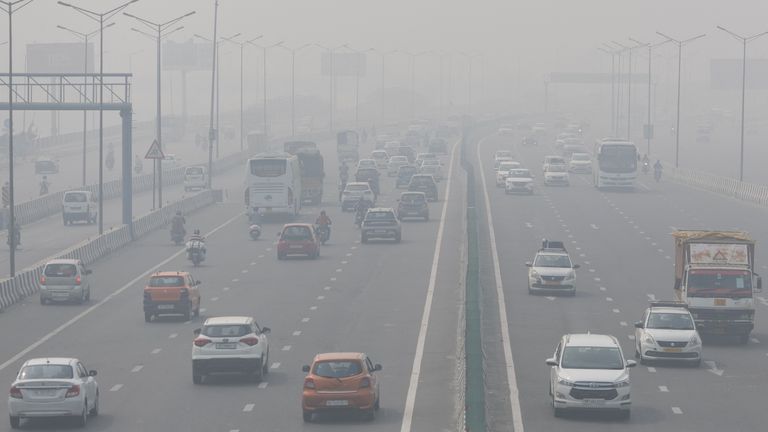
New Delhi: Every winter, Delhi descends into a toxic haze and every winter, the government claims surprise. Despite years of warnings, court orders, scientific evidence and public suffering, the current Delhi government has once again failed to protect citizens from lethal air pollution, exposing a pattern of denial, delay and cosmetic governance.
The capital’s air crisis is no longer a seasonal inconvenience; it is a public health emergency. Yet, instead of long-term planning and decisive action, the government’s response has remained reactive and ad hoc, restricted to emergency measures announced only after air quality slips into the “severe” and “hazardous” categories.
A crisis foreseen, yet ignored:- Air pollution in Delhi is not an unpredictable phenomenon. Scientists, environmental experts and even government-appointed bodies have repeatedly warned that winter conditions, low wind speed, temperature inversion and emissions accumulation, would turn Delhi into a gas chamber unless emissions were curbed well in advance.
Still, the government failed to act during the critical pre-winter window. Construction dust continues to choke neighbourhoods, vehicle emissions remain unchecked, road dust mitigation is poorly enforced, and public transport expansion has failed to keep pace with rising private vehicle ownership. The result: emergency curbs every November, when damage is already done.
Firefighting instead of governance:- The government’s pollution strategy appears to rely on last-minute firefighting, closing schools, banning construction, restricting trucks and appealing to citizens to “stay indoors.” These measures may reduce exposure temporarily, but they do not reduce pollution at the source.
Odd-even schemes, emergency shutdowns and work-from-home advisories have become annual rituals, symbolic actions that create the illusion of governance while avoiding structural reforms. Citizens are asked to sacrifice mobility, livelihoods and education, while polluters face little accountability.
Missed opportunities, weak enforcement:- Delhi’s pollution is driven largely by local sources vehicular emissions, road dust, construction activity and industrial pollution. Yet enforcement remains weak and inconsistent. Pollution control norms are announced but rarely monitored on the ground. Penalties are low, inspections are sporadic, and violators often go unpunished.
Even flagship promises, such as large-scale electric vehicle adoption, effective dust control, and decentralised air quality management, have failed to deliver meaningful results. The absence of ward-level action plans and real-time enforcement exposes a governance gap that no emergency order can bridge.
Health pays the price:-About 17,188 deaths in 2023 in Delhi were linked to long-term exposure to ambient particulate matter (PM2.5), according to Global Burden of Disease (GBD) data analysed by the Institute for Health Metrics and Evaluation (IHME). That’s roughly 15% of all deaths in the city last year attributed to air pollution, meaning 1 in every 7 deaths was linked to toxic air. Deaths linked to air pollution have risen over time , from about 15,786 in 2018 to 17,188 in 2023, highlighting a worsening public health burden despite repeated pollution control efforts.
Human cost of this failure is staggering:- Children breathe toxic air during their most vulnerable years. Elderly residents struggle with aggravated respiratory and cardiac illnesses. Hospitals report spikes in asthma, bronchitis and lung-related complications, year after year. Clean air is not a privilege; it is a constitutional right. When a government repeatedly fails to safeguard this right, it is not a policy lapse, it is governance failure. Delhi’s air pollution crisis is no longer about lack of knowledge or resources.
It is about lack of political will, poor execution and an overdependence on emergency optics instead of systemic solutions. Until the government moves beyond seasonal damage control and commits to sustained, science-driven action, the capital will continue to choke, and citizens will continue to pay the price with their lungs.